
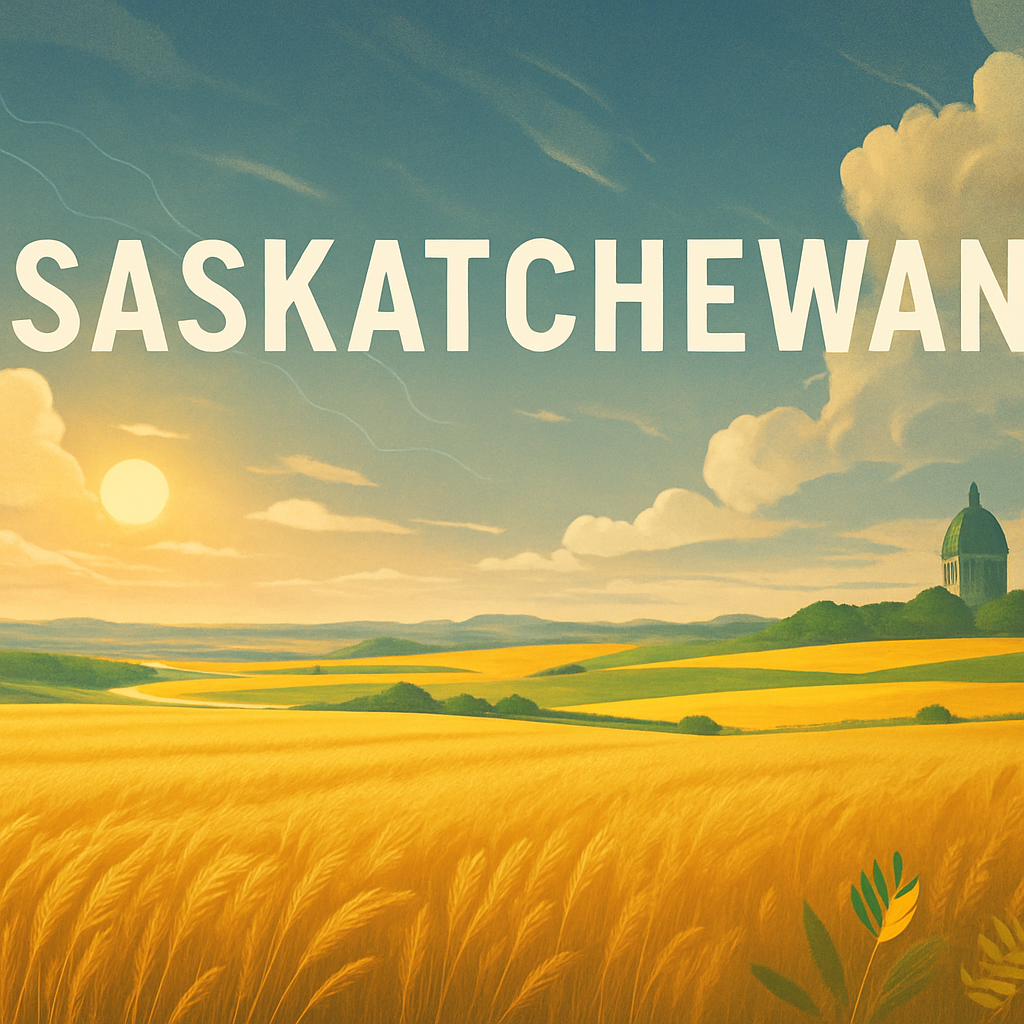
📍 Geography & Population
Location and Geography
- Saskatchewan sits in the heart of Canada’s Prairie region. It is bounded roughly by the provinces of Alberta (west) and Manitoba (east), the Northwest Territories (north), and the U.S. states of Montana and North Dakota (south).
- The province’s geography is dominated by expansive plains and prairie in the south, transitioning into parkland and boreal forest in the north. Large tracts of fertile farmland — especially in the south and central portions — support agriculture. There are also lakes, rivers, and some forested/cold-weather zones up north.
- Because of its flat-to-gently-undulating terrain and continental climate, Saskatchewan experiences hot summers, cold winters, and wide seasonal swings — typical of prairie climates.
Population & Demographics
- Saskatchewan is less populous than Canada’s most populous provinces (like Ontario, British Columbia), but is one of the major “prairie provinces.” (Exact recent population estimates vary with census and growth trends.)
- Major population centres include cities such as Saskatoon and Regina (the provincial capital). These urban areas concentrate much of the province’s economic and cultural life.
- Outside the cities, many people live in small towns, rural communities, and farming areas — reflecting the province’s agricultural heritage and rural economy.
- The population mix includes descendants of early European settlers, immigrant communities, and Indigenous peoples (First Nations, Métis) — reflecting Canada’s broader multicultural and Indigenous heritage.
🕰️ History & Historical Significance
- Indigenous peoples — First Nations and Métis — inhabited what is now Saskatchewan for centuries before European contact, relying on buffalo/bison hunting on the prairies, fishing, and seasonal patterns across the land.
- With European colonization and the fur trade, the region became part of trade routes; as settlement expanded westward, more European settlers arrived, transforming land use toward agriculture and ranching.
- In the late 19th – early 20th centuries, the Canadian government promoted settlement of the Prairie provinces, including Saskatchewan; railways were built; farmland developed; and towns established. Agriculture (grain, wheat) became a foundation of the economy and identity.
- Over time, resource development (farming, later mining, energy, natural resources) and urbanization shaped the province, balancing rural traditions with modern economic diversification.
Saskatchewan has played a central role in Canada’s prairie history — from Indigenous lands, to frontier agriculture, to modern resource-driven economy. Its identity melds rural-prairie heritage, farming communities, multicultural settlement, and evolving industry.
🏛️ Government & Political Structure
- As a Canadian province, Saskatchewan operates under a provincial parliamentary system — with a Legislature, a Premier (head of government), and a Lieutenant Governor as the Crown’s representative.
- The provincial government handles matters within provincial jurisdiction: education, health care, agriculture, natural resources, provincial infrastructure, municipalities, and regional issues.
- Citizens vote in provincial elections to choose members of the legislative assembly; the majority-party (or coalition) forms the government, led by the Premier.
- As part of Canada’s federal structure, Saskatchewan also participates in federal elections and sends representatives (MPs, Senators) to the national Parliament.
Because of its mix of urban and rural populations, resource-based and agricultural economy, and significant Indigenous presence, governance in Saskatchewan often involves balancing diverse interests — farming, resource development, Indigenous rights, rural services, and urban growth.
💼 Economy & Key Economic Factors
Saskatchewan’s economy is shaped by its natural geography (prairies, farmland, resources) and its place in Canada’s agricultural heartland. Major economic factors:
- Agriculture & Agri-Food Production: The province is one of Canada’s major grain and cereal producers — wheat, canola, barley, pulses, etc. Farming and agri-food remain foundational for rural communities and exports.
- Natural Resources & Mining: Beyond agriculture, Saskatchewan has substantial natural resources: mining (minerals, potash, uranium in some areas), energy, and resource extraction — contributing significantly to exports and government revenues.
- Fertilizer & Global Export Links: Potash and mineral fertilizers are important export commodities (given demand globally for agriculture), making Saskatchewan a critical node in international agricultural supply chains.
- Rural & Agricultural-Rural Economy, Small Towns: Many towns and rural municipalities depend on farming, resource-based livelihoods — sustaining communities outside big cities.
- Urban Services, Manufacturing, Transport & Logistics: Cities like Saskatoon and Regina provide services, manufacturing, trade, transport, and act as hubs linking rural hinterlands with broader markets.
- Diversity & Economy Resilience: Because of a mix of agriculture, natural resources, export commodities, urban services, Saskatchewan has a diversified economy — giving resilience against sectoral shocks (e.g. global commodity prices, agricultural yields).
Given its role as a “breadbasket” and resource provider in Canada, Saskatchewan’s economic health is vital to national food security, export earnings, and resource supply — making its economy significant beyond provincial boundaries.
📰 Current Affairs & Challenges (Mid-2020s Context)
Here are several of the key issues, debates, and challenges facing Saskatchewan in recent times:
- Commodity Prices & Global Demand Fluctuations
The province’s economy depends heavily on global commodity markets (grain, potash, minerals). Fluctuations in global demand or prices can strongly affect provincial revenues, rural incomes, and government budgets. - Agriculture Challenges & Climate Risks
As a prairie province, Saskatchewan faces challenges from weather variability — droughts, extreme heat, variable precipitation — which can impact crop yields. Climate change and sustainability of farmland are ongoing concerns. - Resource Development vs Environmental & Indigenous Concerns
Mining, energy, and resource extraction projects often raise debates about environmental protection, land use, water quality, and the rights and participation of Indigenous communities in resource decisions. - Rural-Urban Divide & Population Distribution
Rural communities — especially small towns and remote agricultural zones — may face population drift (young people moving to cities), consolidation of services, and economic pressures. Ensuring balanced development, services, and opportunities across regions remains important. - Economic Diversification & Value-Added Industries
Moving beyond commodity exports: there is ongoing need to support processing (agri-food, manufacturing), technology, innovation, and value-added industries to reduce exposure to global commodity swings and create stable good-paying jobs. - Indigenous Relations, Land Rights & Reconciliation
As in many Canadian provinces, recognition of Indigenous rights, meaningful consultation regarding resource projects, land-use planning, and reconciliation remain key components of political and social life. - Demographic Trends & Growth Management
Balancing population growth (or retention), immigration, urban growth, infrastructure demands — especially in cities — with rural sustainability, farmland preservation, and services for remote or small communities.
✅ Why Saskatchewan Matters — Its Place in Canada
- Saskatchewan is central to Canada’s agricultural production and food security, often called part of Canada’s “breadbasket.” Its grain, pulses, and crop output feed domestic consumption and export markets globally.
- Its resource exports — minerals, potash, energy, natural resources — contribute substantially to Canada’s trade balance and overall resource wealth.
- The province’s mix of rural, agricultural, resource-based, and urban economies makes it a microcosm of many Canadian economic, social, and environmental challenges: balancing growth, sustainability, urbanization, and tradition.
- Saskatchewan’s experience helps illustrate national debates over resource management, Indigenous reconciliation, environmental protection, economic diversification, and rural-urban equity.
- As a province with a strong identity tied to Prairie lands, agriculture, resilience, and community — it showcases an important strand of “Canadian identity” different from coastal or highly urbanized provinces.
🕰️ Saskatchewan — Major Historical & Political Timeline
Pre-contact (thousands of years)
- First Nations — Plains Cree, Saulteaux (Ojibwe), Dene, Dakota, and many other Indigenous nations — live, hunt (notably bison), fish, trade and govern across the prairie and boreal lands for millennia. Métis communities develop through Indigenous–European trade and family networks.
1600s–1700s — Fur trade era
- European presence begins via the fur trade. Hudson’s Bay Company (1670) and North West Company posts, riverine trade routes, and Métis river settlements shape the economy and cross-cultural relations.
Late 1800s — Settlement & Conflict
- Canadian westward expansion, rail construction, and settlement accelerate in the late 19th century. The collapse of bison herds, settler wheat farming, and arrival of homesteaders transform the land.
- 1885 — North-West Rebellion (Resistance): Led by Louis Riel and Métis leaders, armed conflict (including battles such as Batoche) occurs in what is now southern Saskatchewan and neighbouring regions. The uprising is a pivotal and traumatic event in prairie history.
1905 — Provincial founding
- September 1, 1905: Saskatchewan becomes a province of Canada (created from part of the North-West Territories). Regina is designated the provincial capital. (The new province initially had a “postage-stamp” population concentrated in the south.)
Early–Mid 1900s — Agricultural boom, Depression & Prairie life
- Massive wheat and grain production and homesteading reshape the economy and settlement pattern. The Great Depression and Dust Bowl years of the 1930s hit the Prairies hard, prompting migration, policy responses, and institutional innovations.
Mid–Late 1900s — Modernization & resource development
- Mechanization, cooperative movements (notably farming co-ops and credit unions), creation of Crown corporations, and expansion of social programs (Saskatchewan pioneered universal public medicare in the 1960s).
- Discovery and development of mineral resources (potash, uranium) and oil/gas fields begin to diversify the economy.
Late 20th – early 21st century — Diversified economy & politics
- Saskatchewan evolves from strictly agricultural economy to a mix that includes mining (especially potash and uranium), oil and gas, manufacturing, services, and strong export agriculture. Urban growth occurs in Saskatoon and Regina; Indigenous issues and land claims rise in political prominence.
2010s–2020s — Contemporary shifts
- Global demand for potash and agriculture commodities influences provincial fortunes; climate variability, droughts, and international markets affect farmers. Provincial politics have been shaped by alternation between parties emphasizing resource development and those stressing public services and rural sustainability. Indigenous reconciliation, infrastructure for northern communities, and rural revitalization remain central policy threads.
📊 Saskatchewan — Data-Rich Profile Sheet
Note on numbers: below are best mid-2020s estimates and commonly reported facts.
Quick Facts
- Official name: Province of Saskatchewan
- Joined Confederation: September 1, 1905
- Capital: Regina
- Largest city / economic hub: Saskatoon (metro)
- Approx. land area: ~651,900 km² (very large, prairie + boreal + northern areas)
- Population (mid-2020s estimate): ~1.2 million (order-of-magnitude; province among mid-population tier in Canada)
- Time zone(s): Central Standard Time (and parts observe DST)
Geography & Regions
- Southern Prairies: Broad, fertile plains — principal agricultural zone (grain, oilseeds, pulses).
- Parkland & Transition Zone: North of the deep prairie — mixed agriculture/grassland and forests.
- Boreal North: Extensive forests, lakes, muskeg, and resource country (forestry, mining).
- Major water bodies: Saskatoon and Regina watersheds, numerous lakes in the north (e.g., Lake Athabasca on the northern fringe of the province), rivers such as the South and North Saskatchewan Rivers.
Population & Urban Centres (estimates)
- Province population: ~1.15–1.25 million (mid-2020s estimate).
- Major CMAs / cities (approx. metro populations, mid-2020s):
- Saskatoon CMA: ~300–350k (the fastest-growing major centre historically)
- Regina CMA: ~200–250k
- Other notable centres: Prince Albert, Moose Jaw, Yorkton, Swift Current, Lloydminster (border city), Estevan, Weyburn.
Demographics & Identity
- Indigenous presence: Significant First Nations and Métis populations (Indigenous share higher than national average—commonly cited around mid-teens percent range). Indigenous languages, cultures, and governance are important to provincial identity and policy.
- Immigration & labour: Saskatchewan has attracted immigrants (including skilled workers and agricultural labour) and internal migrants at times, contributing to demographic growth and labour supply.
Political & Administrative Structure
- Parliamentary system: unicameral Legislative Assembly of Saskatchewan; MLAs elected in single-member districts.
- Executive: Premier leads the government; Lieutenant Governor represents the Crown (ceremonial and constitutional duties).
- Local government: Cities, towns, rural municipalities, and Indigenous governments/First Nations reserves play roles in local services and governance.
Economy — Key Sectors & Strengths
- Agriculture & Agri-food (core): Wheat, canola, barley, pulses (lentils, peas), oilseed crops, cattle. Saskatchewan is a major global supplier of several commodities. Agriculture drives rural employment, exports, and agribusiness.
- Potash & Fertilizer Minerals: Saskatchewan is one of the world’s leading potash producers (potash is a major provincial export and fiscal earner). Potash supports global fertilizer markets.
- Uranium & Mining: Saskatchewan hosts some of the world’s highest-grade uranium deposits (Athabasca Basin in northern Saskatchewan, though some deposits cross provincial boundaries) — key for nuclear fuel supply and export.
- Oil & Gas: Heavy oil and conventional fields concentrated in the southeast, Weyburn, Lloydminster area (note Lloydminster sits astride AB–SK border). Energy contributes to regional jobs and export revenue.
- Forestry & Northern Resource Economy: Timber, pulp, and forest services in the boreal north; other mineral exploration and mining activity.
- Manufacturing & Value-Added Processing: Agri-processing, machinery, equipment, and food processing add value locally.
- Services & Tech: Growing urban service sectors (finance, education, health, professional services), with some emergent clusters in ag-tech and resource-related innovation.
Trade & Exports
- Saskatchewan’s exports are commodity-heavy: potash, grain & oilseed, uranium, oil — tightly linked to global agricultural markets and commodity cycles.
Natural Resources
- Soils & farmlands: Fertile soils across the southern prairies (some of North America’s key grain lands).
- Minerals: Potash (large reserves), uranium (high-grade deposits), other minerals across the north.
- Fresh water & ecology: Major river systems supporting irrigation, ecosystems and communities.
📰 Pertinent Current Affairs & Policy Issues (mid-2020s)
(These are high-priority themes often discussed across provincial media, policy forums and politics.)
- Commodity price volatility & fiscal implications
- Potash, oil and grain prices strongly affect provincial revenues and rural incomes. Budget planning and public investment can swing with global commodity cycles.
- Climate risk for agriculture
- Drought, extreme heat, variable precipitation, and changing growing seasons are top concerns for farmers; adaptation and resilient cropping systems are policy priorities.
- Indigenous reconciliation, land claims and consultation
- Treaty rights, co-management of lands, participation in resource projects, and implementation of reconciliation commitments remain central political issues.
- Rural population retention & service delivery
- Small towns face population decline or aging; attracting/retaining youth and professionals (healthcare, teachers) is a shared challenge.
- Value-added processing & economic diversification
- Moving up the value chain (processing potash, refining ag product, ag-tech) is a stated goal to reduce vulnerability to raw-commodity cycles.
- Infrastructure & northern development
- Roads, broadband, and northern community infrastructure (housing, water systems, health facilities) need investment to support resource projects and community well-being.
- Environmental assessment & resource trade-offs
- Debates around mining, oil extraction methods, and land disturbance require balancing economic benefits with water, habitat and long-term sustainability concerns.
- Labour markets & immigration
- Attracting skilled labour and seasonal/agriculture workers—plus immigration policies tuned to rural needs—are recurring policy levers.
🧩 Why Saskatchewan Matters (nationally & globally)
- Saskatchewan supplies food (grain & pulses) and critical minerals (potash, uranium) that feed global agriculture and energy systems — giving it outsized importance relative to its population.
- The province exemplifies policy trade-offs faced by resource regions: how to encourage economic development while protecting ecosystems and honouring Indigenous rights.
- Its agricultural and resource capacities are central to Canada’s export economy and to food security in global markets.
✅