
📍 Geography and Demographics
Location & Size
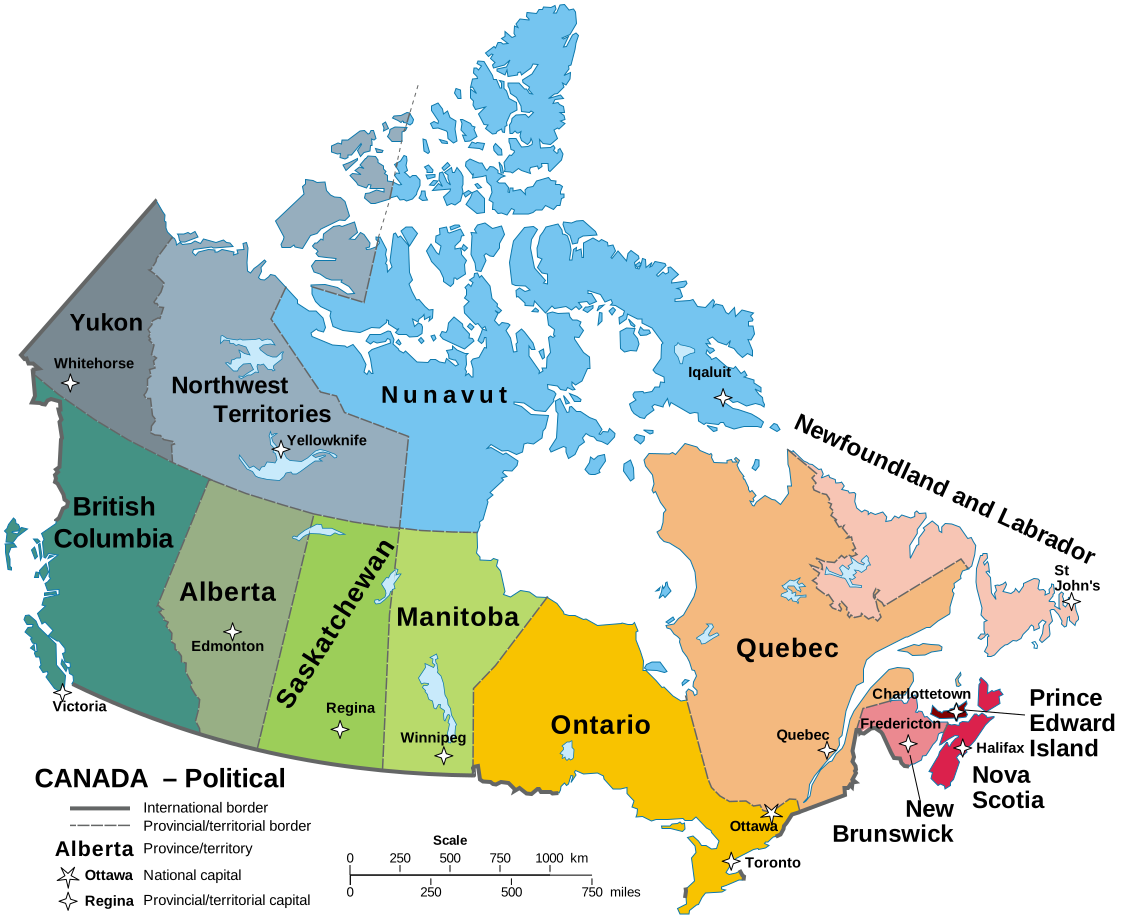
- Ontario is located in east-central Canada, bordered by Quebec to the east, Manitoba to the west, Hudson Bay and James Bay to the north, and the United States (via Great Lakes / St. Lawrence River) to the south. (Encyclopedia Britannica)
- It covers about 1,076,395 square kilometres (≈ 415,599 square miles), making it the second-largest province in Canada by area (after Quebec). (Encyclopedia Britannica)
- Ontario spans significant geographic diversity: from densely populated Great Lakes–St. Lawrence lowlands in the south, to remote northern forests and the Canadian Shield, to far-flung northern reaches. (Encyclopedia Britannica)
Population
- As of 2025, Ontario’s estimated population is around 16.26 million. (Ontario)
- The province accounts for roughly 39–40% of Canada’s total population. (Ontario)
- Ontario is highly urbanized: over 85% of residents live in urban centres, mainly in southern Ontario near the Great Lakes. (Ontario)
- Major metropolitan areas include: Toronto (the provincial capital and Canada’s largest city), the Greater Toronto Area (GTA), Ottawa (the national capital city, though part lies in Quebec), and other cities such as Hamilton, Kitchener-Waterloo, London, and Windsor. (Ontario)
- Demographics: Ontario’s labour force in 2024 was around 8.75 million, with ~8.15 million employed and an unemployment rate around 7.0%. (Ontario)
- Compared to the national average, Ontario draws a large share of immigrants and newcomers, fueling growth and diversity especially in Greater Toronto and other urban hubs. (feddev-ontario.canada.ca)

Population Projections
- According to official projections, Ontario’s population is expected to grow by about 27.4% over 2024–2051, increasing by over 4.4 million people — reaching over 20.5 million by 2051 under a reference scenario. (Ontario)
🕰️ History & Historical Significance
- Ontario joined the Canadian Confederation in 1867, when the original provinces were united under the British North America Act, 1867 (now part of the constitutional framework). (Encyclopedia Britannica)
- Over generations, Ontario evolved from agricultural and resource-based economies to become Canada’s industrial and economic power-house. (Encyclopedia Britannica)
- Its growth was shaped heavily by immigration, industrialization (especially manufacturing), urbanization around Great Lakes and southern corridors, and later diversification into services, technology, finance, and knowledge-based industries. (feddev-ontario.canada.ca)
- As the most populous and economically influential province, Ontario has long played a central role in national politics, culture, economy—even sometimes drawing criticism or regional tension from other provinces due to its dominance. (Encyclopedia Britannica)
🏛️ Government & Political Structure

- Ontario has a provincial government that operates under the Canadian federal system. Its government is modeled on the parliamentary system at the provincial level. (Encyclopedia Britannica)
- The province’s capital is Toronto. (Encyclopedia Britannica)
- The legislative body is the Legislative Assembly of Ontario, consisting of elected Members of Provincial Parliament (MPPs). The most recent election, held on February 27, 2025, produced the 44th Parliament of Ontario. (Wikipedia)
- After the 2025 election, the Progressive Conservative Party of Ontario (led by Doug Ford) won a majority, giving them a third consecutive majority government — a feat not seen since 1959. (Wikipedia)
- Because Ontario is part of Canada’s federal structure, certain powers are under provincial jurisdiction (health care, education, provincial infrastructure, portions of justice, etc.), while others remain federal (defence, national economic policy, immigration to a degree, etc.).
💼 Economy & Key Economic Factors
Ontario is often described as the economic engine or “pacemaker” of Canada. (Encyclopedia Britannica)
Economic Size and Diversity
- Ontario generates roughly 38–39% of Canada’s GDP. (Ontario)
- The economy is highly diversified: while the service sector accounts for the large majority of economic activity, manufacturing remains vital, especially in autos, industrial goods, advanced manufacturing, and more recently clean-tech, pharmaceuticals, medical devices, and ICT. (Ontario)
- Ontario is a major export hub — particularly of manufactured goods — and a critical node in North American manufacturing supply chains. (Ontario)
Emerging and Growth Sectors
- Knowledge-intensive sectors — including information & communications technology (ICT), finance, professional services, life sciences, tech, and innovation — are increasingly central, showing strong growth over the past decade. (feddev-ontario.canada.ca)
- Southern Ontario, especially around the GTA and other urban corridors, is a hotspot for investment, innovation, startups, and venture-capital funding. (feddev-ontario.canada.ca)
Labour Market & Exports
- Labour force participation remains high, with a large share employed in services, skilled trades, manufacturing, and high-tech sectors. As of 2024, employment rose by 140,000 jobs over the previous period. (Ontario Budget)
- The province is also a major exporter — goods from Ontario represent a significant portion of Canada’s total exports. (feddev-ontario.canada.ca)
📰 Current Affairs & Key Challenges (as of 2025)
• Fiscal and Economic Pressure from Global Trade & Tariffs
- In 2025, the province faces economic headwinds due to tariffs from the United States on key export sectors (such as autos, steel, aluminum), which has affected Ontario’s trade-heavy economy. (Reuters)
- Ontario’s fiscal outlook reflects this: for the 2025–26 fiscal year, the province forecast a budget deficit of C$13.5 billion, down slightly from earlier projections but still well above pre-pandemic levels. (Reuters)
- Growth projections have been revised downward: real GDP growth estimated at 0.8% in 2025, modest increase in 2026, with more robust growth expected later. (Ontario Budget)
• Legislative Changes: New Economic Policy & Zoning Rules
- In June 2025, the provincial government passed the Protect Ontario by Unleashing our Economy Act, 2025 (commonly “Bill 5”), which allows the government to designate “special economic zones” — areas that may be exempt from certain provincial laws/regulations to encourage development. (Wikipedia)
- The government signaled intent to designate resource-rich areas — such as the Ring of Fire (Northern Ontario) mining region — as special economic zones, potentially accelerating resource development and industrial investment. (Wikipedia)
- This has stirred debates over environmental protection, Indigenous rights, land-use regulation, and long-term impacts — a controversy likely to shape Ontario’s economic and social future.
• Political Landscape & 2025 Provincial Election
- On February 27, 2025, Ontario held a general election. The Progressive Conservative government, led by Doug Ford, won a third consecutive majority — the first time since 1959 that a party has done so in Ontario. (Wikipedia)
- That political context will strongly influence how Ontario navigates its economic challenges, trade uncertainty, infrastructure needs, and social services over the next term.
• Demographic and Urban Growth Trends
- Ontario continues to grow and urbanize. Population projections suggest growth to over 20.5 million by 2051. (Ontario)
- Much of that growth is expected in urban and suburban areas — putting pressure on housing, infrastructure, transportation, education, and services.
✅ Why Ontario Matters — National Significance
- Ontario remains Canada’s demographic powerhouse, housing about 2 in 5 Canadians. Its population size, diversity, and economic activity make it a central driver of national trends, policies, and culture.
- Its economy — broadly diversified from manufacturing to high-tech and services — provides a large share of Canada’s GDP, exports, and employment (both blue- and white-collar).
- Ontario’s political decisions—whether on economic policy, resource development, infrastructure, or social services — often set tone for national debates, given its economic weight and population.
- Socially and culturally, Ontario is a hub for immigration, innovation, multiculturalism, and economic mobility — shaping Canada’s identity and future.
🧩 Challenges & Opportunities Ahead
As Ontario moves forward, it faces several intertwined challenges and opportunities:
- Navigating global economic headwinds (trade tensions, shifting demand, inflation), while sustaining growth through diversification and innovation.
- Managing population and urban growth: housing supply and affordability, transit and infrastructure, social services, regional equity.
- Balancing economic development (especially in resource-rich or rural/northern regions) with environmental protection, Indigenous rights, and sustainability — especially in light of laws like the 2025 “special economic zones” legislation.
- Maintaining competitiveness in technology, life sciences, manufacturing (including transition to green/clean-tech) to adapt to changing global markets.
- Ensuring social cohesion, inclusion, and public services as the population grows and becomes more diverse.
🕰️ Key Historical & Political Timeline: Ontario

| Year / Period | Event / Significance |
|---|---|
| 1791 | Passage of the Constitutional Act, 1791 by the British Parliament — which created the colony of Upper Canada (now Ontario) with its own colonial government, separating it from Lower Canada (now Quebec). (Legislative Assembly of Ontario) |
| 1792 | First meeting of the Legislature of Upper Canada, marking the commencement of formal colonial governance. (Legislative Assembly of Ontario) |
| 1793 | The capital of Upper Canada was moved to York (renamed Toronto). (Ontario) |
| Early 1800s | Immigration of settlers — including many Europeans (e.g. Irish, Scots, Germans) — increasing the colony’s population and diversity. (Encyclopedia Britannica) |
| 1841–1866 | Period during which Upper Canada became part of the larger entity Province of Canada (with Canada West corresponding roughly to Ontario) — part of pre-Confederation political evolution. (Encyclopedia Britannica) |
| 1867 (Confederation) | Under the British North America Act, 1867, Ontario became one of the four original provinces of the newly formed Dominion of Canada. Province’s capital: Toronto. (Encyclopedia Britannica) |
| December 27, 1867 | First session of the modern Ontario legislature convened under the new provincial government system. (Legislative Assembly of Ontario) |
| 1872–1896 | Tenure of Oliver Mowat as Premier of Ontario — a period marked by foundational reforms in education, labour, and development, shaping Ontario’s institutions. (Legislative Assembly of Ontario) |
| 1893 (April 4) | Official opening (though still incomplete) of the current parliamentary building — the Ontario Legislative Building in Toronto, seat of the provincial legislature. (Wikipedia) |
| 20th–21st centuries | Transition from a largely resource-based and agricultural economy toward a diversified industrial, manufacturing, service, finance, and knowledge/economy province. (Encyclopedia Britannica) |
| 2020s (recent data) | Ontario continues as Canada’s most populous and economically significant province, driving national GDP, exports, immigration, and innovation growth. (feddev-ontario.canada.ca) |
📊 Ontario at a Glance — Profile Sheet (2024–2025 Data)

General & Geographic Facts
| Attribute | Value / Description |
|---|---|
| Official Name | Province of Ontario (Encyclopedia Britannica) |
| Capital City | Toronto (Encyclopedia Britannica) |
| Total Area | ≈ 1,076,395 km² (≈ 415,599 sq mi) — making it the second-largest province by area (after Quebec) (Encyclopedia Britannica) |
| Geographic Boundaries | Bordered by: • Province of Manitoba (west) • Province of Québec (east & northeast) • Hudson Bay & James Bay (north) • U.S. states along Great Lakes and St. Lawrence (south) (Wikipedia) |
| Natural Regions | Broadly divided into: • Northern Ontario — largely part of the ancient Canadian Shield: rocky terrain, dense forests, vast lakes and rivers, rugged landscape. (Encyclopedia Britannica) • Southern Ontario — more gentle terrain, fertile soils, lowlands and plains, higher population density, agriculture and urban development. (Encyclopedia Britannica) |
| Highest Point | Ishpatina Ridge — 693 m (2,274 ft) above sea level (in the Temagami / Northern Ontario region) (Encyclopedia Britannica) |
| Time Zones | Mostly Eastern Time Zone; some parts of western/northern Ontario observe Central Time. (Wikipedia) |
Population & Urbanization
| Metric / Description | Latest / Approximate Data |
|---|---|
| Total Population (2024) | 16,124,116 (≈ 39.1% of Canada’s total population) (Ontario) |
| Urbanization Rate | Approximately 85.9% of the population resides in urban areas. (Wikipedia) |
| Major Population Centres (2024) | – Greater Toronto Area (GTA): ≈ 7,670,678 (Ontario) – Other large CMAs: Ottawa-Gatineau (Ontario portion), Hamilton, Kitchener–Waterloo, London. (Ontario) |
| Immigration / Diversity | About 30.0% of Ontario residents are foreign-born (2024 data) — reflecting high rates of immigration and multiculturalism. (Ontario) |
Economy & Industry
| Indicator / Sector | Data / Notes |
|---|---|
| GDP (2024 nominal) | CA$ 1,178,353 million — representing ≈ 38.4% of Canada’s GDP. (Ontario) |
| Economic Output by Sector (2023/2024) | From a 2023 profile: goods-producing sectors represent ~22.7% of GDP (manufacturing ~10.8%), while services ~77.3%. (Parliamentary Library of Canada) |
| Leading Industries / Strengths | Manufacturing (especially automotive, industrial goods), finance and insurance, real estate and leasing, professional/scientific/technical services, life sciences, ICT, research & innovation, export trade. (feddev-ontario.canada.ca) |
| Export / Trade Role | Ontario is a major export hub: large portion of Canada’s goods exports originate there; integrated into North American supply chains. (feddev-ontario.canada.ca) |
| Innovation & Business Landscape (2020s) | Numerous post-secondary institutions (STEM output), many incubators/accelerators, a strong venture capital presence — making Ontario a key hub for innovation and emerging industries. (feddev-ontario.canada.ca) |
| Regional Economy – Northern Ontario | Northern Ontario contributes around CA$ 34.6 billion (≈ 4% of Ontario’s GDP in 2024). The region includes ~856,193 people (about 6% of province population), many Indigenous communities, and numerous small municipalities and First Nations communities. Economic activity driven by SMEs, resource industries, forestry, mining, and opportunities under regional growth strategies. (FedNor) |
Political / Administrative Setup
- Ontario operates under Canada’s federal system, with its own provincial government exercising jurisdiction over areas like health care, education, provincial infrastructure, justice (in part), and more. (Encyclopedia Britannica)
- The provincial legislature sits in the historic Ontario Legislative Building in Toronto, established in its present form since the late 19th century. (Wikipedia)
- Historically and politically, Ontario has been central to national development, often playing the role of economic engine, political influence, and population centre — shaping federal direction and national debates. (Encyclopedia Britannica)