
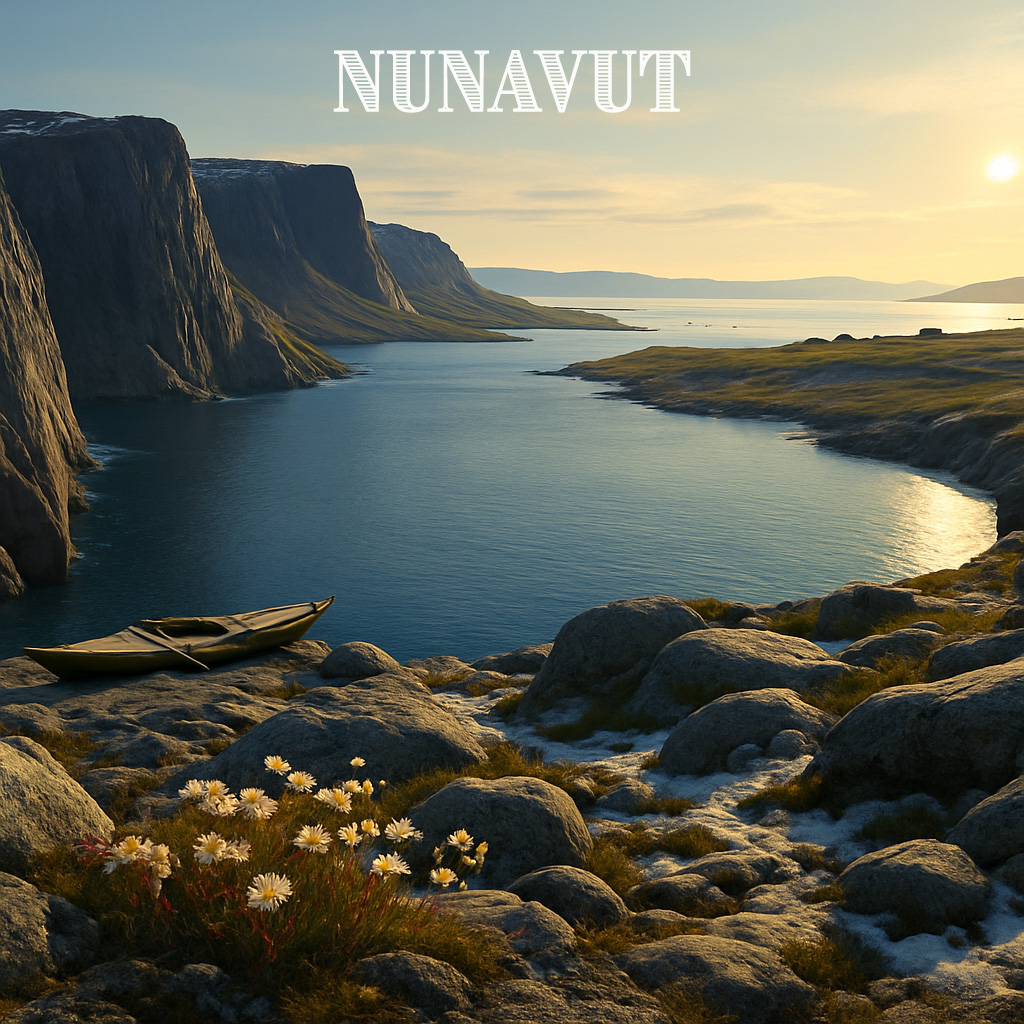
Nunavut — Territorial Overview
1. Introduction
Nunavut is Canada’s largest, northernmost, and newest territory — established in 1999 to recognize Inuit self-determination and cultural identity in Canada’s Arctic. It covers nearly one-fifth of Canada’s land mass but has one of the smallest populations, predominantly Inuit, with a rich cultural heritage deeply tied to the Arctic environment.
2. Geography & Environment
Location & Size
- Nunavut spans the eastern Arctic and includes most of the Canadian Arctic Archipelago.
- It is vast — approximately 2 million square kilometers, making it the largest of Canada’s provinces/territories by area.
Landscape & Climate
- Dominated by Arctic tundra, islands, ice caps, fjords, and permafrost.
- Phenomena such as the Midnight Sun (continuous daylight in summer) and Polar Night (long darkness in winter) are experienced above the Arctic Circle.
- Extreme sub-arctic and polar climate with long, cold winters and short, cool summers.
Ecology
- Home to iconic Arctic wildlife: polar bears, narwhal, beluga, walrus, Arctic fox, caribou, seals, and migratory birds.
- Sensitive ecosystems are vulnerable to climate change: diminishing sea ice, thawing permafrost, and shifting species distributions.
Natural Resources
- Significant mineral potential (diamonds, gold, iron, rare earth elements), hydrocarbons, and freshwater resources.
- Large areas remain under active exploration and Indigenous stewardship.
3. Population & Demographics
Population
- Nunavut has one of the smallest populations in Canada, concentrated in a handful of communities across the territory. The territorial capital, Iqaluit, is the largest settlement and administrative center.
Demographic Features
- A very high proportion of the population identifies as Inuit — the majority cultural group.
- The population profile skews younger relative to national averages.
- Many communities are remote and accessible primarily by air or seasonal sea lift.
Cultural Landscape
- Inuit languages, arts, and cultural traditions are integral.
- Inuinnaqtun and Inuktitut are widely spoken alongside English and French.
- Cultural preservation is a key priority for territorial policy and identity.
4. History
Pre-Contact Era
- Inuit ancestors and earlier Paleo-Eskimo cultures lived in these lands and waters for millennia, adapting to extreme environments with deep ecological knowledge.
European Contact
- Beginning in the 16th–17th centuries, European exploration, whaling and trading expanded into Arctic waters, bringing contact and later impacts on Indigenous life.
20th Century
- Administrative control passed from the Hudson’s Bay Company to the Government of Canada over the Arctic territories.
- Inuit leaders and communities worked for decades to secure land rights and political recognition.
Creation of the Territory (1999)
- On April 1, 1999, Nunavut was established as a separate territory, carved out of the Northwest Territories under the Nunavut Act and the Nunavut Land Claims Agreement — one of the most significant Indigenous land claim and self-government frameworks in Canadian history.
5. Government & Political Structure
Territorial Government
- Nunavut operates under a consensus government — like the Northwest Territories — with MLAs (Members of the Legislative Assembly) elected as independents.
- The MLAs choose the Premier and Executive Council (Cabinet) from among themselves.
- Commissioner: represents the federal Crown in Nunavut (role similar to a Lieutenant Governor in a province, but set within the territorial/federal framework).
Indigenous Self-Determination
- The Nunavut Land Claims Agreement underpins land, wildlife management, resource revenue sharing, cultural preservation, and Inuit rights — a foundational constitutional document.
6. Economy & Significant Sectors
Nunavut’s economy is shaped by its geography, remote communities, and cultural priorities.
a. Public Administration & Services
- Government (territorial and local), health care, education and social services are among the largest employers due to the high role of public services in remote communities.
b. Resource & Mineral Development
- Ongoing exploration and production for minerals (e.g., gold, iron, copper) and potential development of hydrocarbons and critical minerals.
c. Arts, Crafts & Cultural Industries
- Inuit art, carving, printmaking and cultural tourism form a significant niche economic sector with global recognition.
d. Fisheries & Traditional Harvesting
- Marine resources — fishing, seal harvests, subsistence activities — remain culturally and economically important.
e. Tourism
- Arctic tourism (wildlife viewing, Northern Lights, cultural tours) provides seasonal revenue, but is limited by high costs and access challenges.
f. Challenges & Constraints
- Extremely high costs of transport, infrastructure, energy, and construction.
- Small local market, limited economies of scale.
- Dependence on federal transfers to support core services.
7. Current Affairs & Policy Issues (Mid-2020s)
1) Climate Change & Environmental Impact
- Melting sea ice and thawing permafrost are among the most acute effects of climate change in Canada — impacting infrastructure, traditional ways of life, wildlife, and community safety.
2) Infrastructure & Connectivity
- Lack of all-weather road networks; heavy reliance on air travel and seasonal sealift for goods.
- High energy and living costs drive policy interest in localized renewable energy and improved supply chains.
3) Housing & Social Services
- Shortage of quality housing, overcrowding, and associated health/social challenges are ongoing concerns in many communities.
4) Resource Exploration vs Environmental Stewardship
- Balancing mineral/hydrocarbon exploration with ecological protection and Indigenous priorities under land claims frameworks.
5) Culture & Language Preservation
- Sustaining Inuit languages (Inuktitut, Inuinnaqtun) and cultural practices in the face of demographic and economic pressures.
6) Economic Diversification & Youth Opportunity
- Growing youth population calls for stable employment, education, and opportunity without overreliance on government or resource extraction alone.
8. Significance of Nunavut in Canada
Nunavut is central to Canada’s Arctic identity and strategic sovereignty — geographically, culturally, and politically:
- Northern sovereignty: The territory extends Canada’s jurisdiction deep into the Arctic, including territorial waters and the Northwest Passage.
- Indigenous governance precedent: The Nunavut Land Claims Agreement is a cornerstone of Indigenous rights and co-management of land and resources.
- Climate frontlines: Nunavut is among the first places in Canada where climate change effects are profoundly visible, informing national and global climate policy.
- Cultural distinctiveness: With a majority Inuit population and distinct languages, Nunavut preserves and promotes heritage integral to Canadian diversity.
9. Key Numeric & Reference Data (summary)
| Indicator | Approx. Value / Description |
|---|---|
| Population (2024–2025) | ~45,000 (very low density) |
| Land Area | ~2,000,000 km² (largest territorial footprint) |
| Capital | Iqaluit |
| Major Communities | Iqaluit, Rankin Inlet, Arviat, Cambridge Bay, Pangnirtung |
| Official Framework | Nunavut Act; Nunavut Land Claims Agreement |
| Government | Consensus Parliament (no political parties) |
| Key Sectors | Public administration, resource development, arts & crafts, fisheries, tourism |