
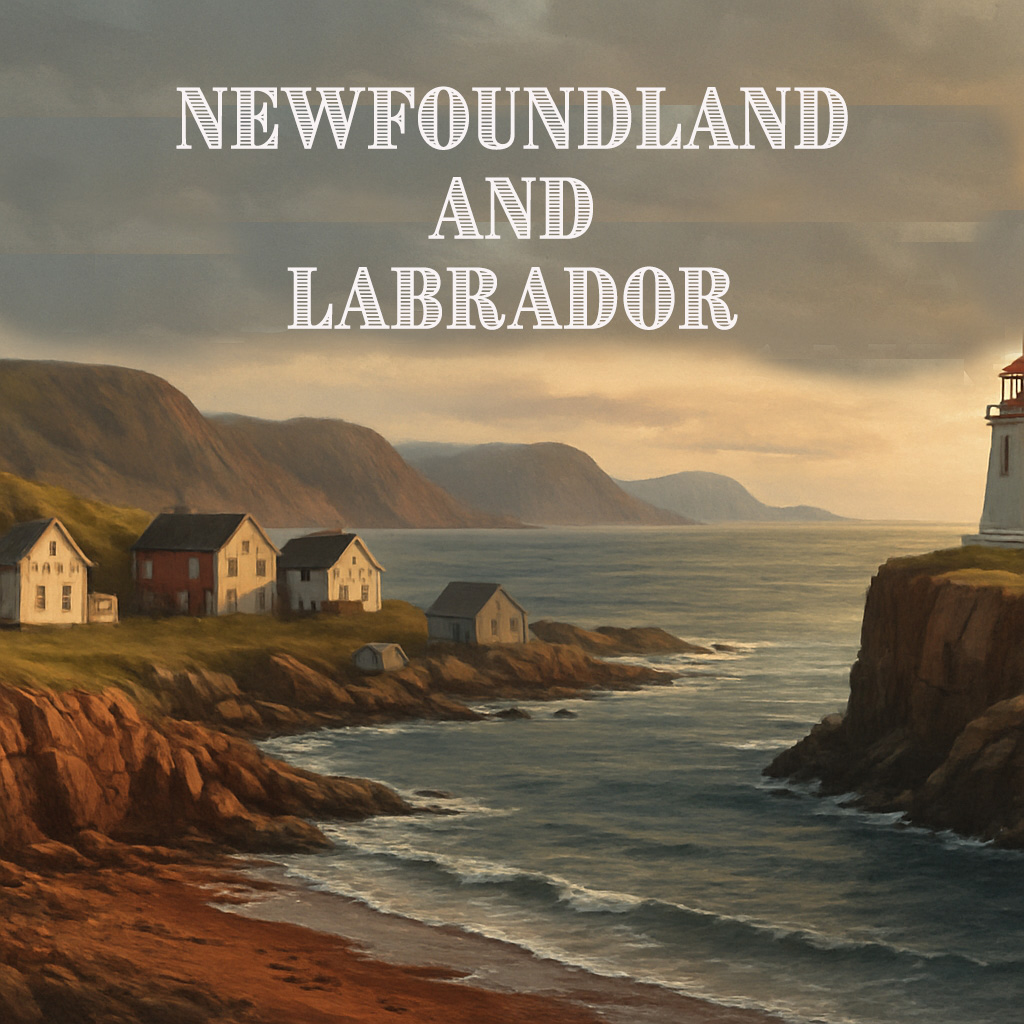
Newfoundland and Labrador — Provincial Overview
1. Introduction
Newfoundland and Labrador occupies the easternmost place in Canada — comprised of the island of Newfoundland in the Atlantic, plus the mainland region of Labrador. Its history, people, geography and economy are shaped by the sea, its rugged climate, resource-rich but remote terrain, and a long heritage of fishing, shipping, indigenous presence, and resource development.
2. History & Historical Significance
Indigenous History
- Long before European contact, the land and waters of Newfoundland and Labrador were home to Indigenous peoples — including the Innu (in Labrador), the Inuit, and the Mi’kmaq (on parts of the island). These peoples lived by marine and land hunting, fishing, seasonal migration, and maintained rich cultural traditions tied to the sea, coast, and subarctic environment.
European Contact & Early Settlement
- From the early 1500s onward, European fishermen (especially from England, Portugal, France, Spain) began seasonal voyages to Newfoundland’s rich cod fisheries.
- Permanent settlement developed over time; fishing, sealing, and maritime industries became central to the island’s economy and way of life.
20th Century: From Dominion to Province
- Newfoundland was a British dominion (self-governing) for much of early 20th century. Economic hardship, war, and costs led to suspension of self-government under a Commission of Government (1930s–1940s).
- After debate and referenda, Newfoundland (plus Labrador) joined the Canadian Confederation in 1949 — becoming the tenth province.
- Post-confederation decades saw efforts to modernize economy, infrastructure, social services; investments to integrate the province into national economy.
Resource Development Era (Late 20th Century – 21st Century)
- Offshore oil discoveries (e.g., Grand Banks) transformed the economic prospects of the province — creating a new pillar beyond fisheries.
- At the same time, traditional fishing and resource extraction have faced challenges (stock collapse, regulation, shifting global markets), prompting calls for diversification and sustainable resource management.
3. Geography, Population & Demographics
Geography & Natural Environment
- The province is divided into two main parts: the island (Newfoundland) and the mainland region (Labrador).
- Geography includes: Atlantic coastline, rugged cliffs, fjords, forests, boreal zones, subarctic climate in Labrador, maritime climate on island.
- The marine environment — cold Atlantic waters, rich fisheries, icebergs — has historically shaped settlement patterns, livelihoods, and culture.
Population
- As one of Canada’s less populous provinces, Newfoundland and Labrador has a relatively small population compared to large mainland provinces.
- Population centers concentrate along the coast and on or near the island; rural and remote communities — especially in Labrador — remain significant.
- The social fabric includes long-established fishing/farming families, Indigenous communities, and more recent migrants; the mix reflects maritime heritage, resource dependence, and cultural diversity.
4. Government & Political Structure
- Newfoundland and Labrador operates under Canada’s provincial parliamentary system: a Legislative Assembly, elected Members of the House, a Premier, and a Lieutenant Governor as Crown’s representative.
- As part of the Canadian federation, it participates in federal elections and sends representatives (MPs and Senators) to Canada’s Parliament.
- Because of its geography (island + remote mainland) and Indigenous presence, governance must balance regional infrastructure, remote-community service delivery, resource management, and cultural/land rights.
5. Economy & Key Economic Factors
The economy of Newfoundland and Labrador is shaped by its natural environment, maritime heritage, resource base, and the challenges of remoteness. Key sectors and economic factors:
Fisheries and Marine Industries
- Historically, fishing — especially cod, sea food, shellfish — was the backbone of the economy and sustenance.
- Seafood, shellfish harvesting, aquaculture remain important for coastal and island communities.
Offshore Oil & Gas
- Offshore oil discoveries (e.g. in Grand Banks) have become a major economic pillar in recent decades.
- Oil and gas production, offshore drilling, and associated industries contribute significantly to provincial revenues and employment (though subject to global energy price fluctuations).
Mining and Natural Resources
- Forestry, mining (minerals, ore), and natural-resource extraction, especially in Labrador and parts of the island, contribute to regional economies.
- Hydro-electricity potential, freshwater and forest resources— some remote, some accessible — remain part of long-term economic planning.
Tourism and Cultural Heritage
- Natural beauty: rugged coastline, icebergs, fjords, northern lights (in Labrador), forested areas.
- Cultural heritage: Indigenous history, fishing villages, maritime traditions — attractive for heritage and eco-tourism.
- Tourism supplements resource-based and marine-based economy, particularly in coastal and island zones.
Public Sector & Services
- Given the dispersed population, remote communities, and geography, public services (healthcare, education, social services) are major employers and critical infrastructure.
- Government plays a large role in economic stabilization, service delivery, and supporting remote areas and Indigenous communities.
6. Current Affairs & Key Challenges (Mid-2020s)
As of 2023–2025, several issues shape policy, society, and the future of Newfoundland and Labrador:
Economic Vulnerability & Diversification
- Dependence on offshore oil and volatile global energy markets exposes the provincial economy to boom-bust cycles.
- Efforts and debates are ongoing about diversifying beyond oil and fisheries — including sustainable resource management, renewable energy, tourism, value-added processing.
Fisheries Sustainability & Marine Ecosystem Health
- Declines or fluctuations in fish stocks, changing ocean conditions, climate impact on marine ecosystems — all pose risks to traditional coastal economies.
- Need for sustainable quotas, conservation, and modernization of marine industries.
Remote and Rural Community Infrastructure
- Many communities are small, remote, and face challenges: connectivity, transport, access to healthcare/education, out-migration.
- Infrastructure investment, support for local economies, and sustaining population are ongoing policy priorities.
Indigenous Rights, Land Claims, and Reconciliation
- Recognition of Indigenous title, treaty discussions, rights to land and resources (especially in Labrador) — integral to policy, development, and social justice.
- Balancing resource development with Indigenous consultation, environmental respect, and community consent.
Demographic Challenges & Population Retention
- Young people may emigrate for opportunities elsewhere.
- Aging population in some regions, shrinking rural towns, seasonal economies create demographic and social pressures.
- Boosting immigration, improving economic opportunity, and stabilizing communities are priorities.
Environmental & Climate Change Impact
- Coastal erosion, changing sea levels, ocean warming, shifting marine wildlife patterns — affect fisheries, coastal communities, traditional ways of life.
- Northern Labrador especially vulnerable to extreme climate, ice changes, and remote isolation.
7. Significance of Newfoundland and Labrador
- As Canada’s easternmost province — island + mainland — Newfoundland and Labrador provides a unique Atlantic and Arctic-influenced perspective in national affairs.
- Its mix of marine economy, resource economy, Indigenous heritage, and remote geography offers a case study in balancing development, sustainability, and cultural identity.
- The province’s challenges — from economic diversification to infrastructure, from climate change to reconciliation — reflect many of the broader issues facing resource-rich, remote, and culturally diverse regions in Canada and globally.
- Its history and ongoing adaptation demonstrate resilience, community strength, and the complex interplay between nature, identity, resources, and modern governance.
📈 Newfoundland and Labrador — Key Statistics & Economic Data (Reference Table)
| Attribute / Indicator | Approximate Value / Notes |
|---|---|
| Population (2023 estimate) | ~ 520,000 – 540,000 |
| Land Area | ~ 405,212 km² (including island and mainland Labrador areas) |
| Population Density | Low overall — population concentrated along the coast and in a few urban centres; many remote/rural areas |
| Largest Urban Centres | • St. John’s — provincial capital and largest city • Other towns: coastal communities, fishing villages, small interior or Labrador communities |
| Economy — Major Sectors / Industries | Seafood & Fisheries; Offshore Oil & Gas; Mining & Natural Resources; Tourism and Cultural Heritage; Public & Social Services; Small-scale manufacturing/processing |
| Seafood / Fisheries Output Share | Seafood and shellfish remain a key employer and export commodity across coastal communities (shellfish, lobsters, cold-water seafood) — core sector for rural coastal economy |
| Offshore Oil & Gas Production | Offshore oil (off the island’s continental shelf) represents a major export and revenue source for the province; a central component of the modern economy (oil & gas extraction, services, employment) |
| Natural Resources & Land-based Industries | Forestry (in suitable regions), mining (minerals, ores), hydro / freshwater & forestry potential in some inland areas or Labrador parts — resource base beyond marine and oil sectors |
| Tourism & Heritage / Eco-Tourism Value | Coastal scenery, Atlantic-sea climate, historical fishing villages, cultural heritage sites, and natural beauty drive seasonal tourism — important supplementary income for many communities |
| Economic Diversification & Public Sector Employment | Due to geography and population distribution, public services (healthcare, education, local governance) constitute a significant portion of employment outside resource/seasonal sectors |
| Challenges: Economic Dependence & Market Volatility | Reliance on global markets for oil and seafood prices; vulnerability to global demand changes, environmental regulation, and resource sustainability pressures |
| Demographic & Social Features | Many small, isolated or remote communities; coastal fishing villages; aging populations in some regions; migration (youth moving to mainland or outside province) — demographic pressures in rural/remote zones |
🛠 Notes & Context on Data
- Because Newfoundland and Labrador has a small population and many remote/rural communities, raw per-capita and density figures can be misleading: much of the population is clustered in a few coastal towns, while large areas remain sparsely inhabited.
- The economy is multi-pillar: while oil & gas and fisheries are often highlighted, resource extraction, public services, tourism, and small-scale industries all play important roles — especially for regional and rural stability.
- Many sectors (e.g., fisheries, tourism) are seasonal or cyclical, so employment and output vary year to year depending on markets, regulation, and environmental conditions (weather, ocean ecosystems, global demand).
- Sustainability and diversification remain critical long-term goals: reliance on a few volatile sectors makes resilience, environmental protection, and economic planning especially important for the province’s future.