

📍 Geography & Population
Location and Geography
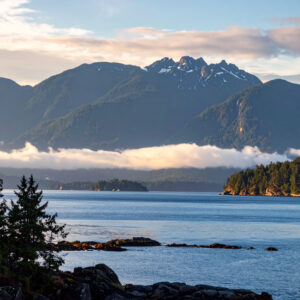
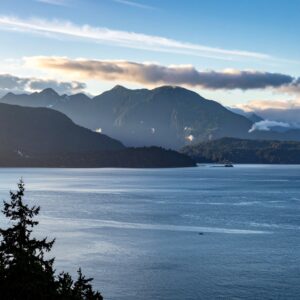
- British Columbia is Canada’s westernmost province. It has a long Pacific coastline, and its terrain is famously diverse: coastal fjords and islands, temperate rainforests, rugged coastal mountains (including the Coast Mountains), interior plateaus and valleys, and in the far north, more remote wilderness.
- Its coastal location, mountains, forests, and varied climate zones — from mild maritime climate on the coast to colder, alpine or interior conditions — shape its environment, ecosystems, and how people live across the province.
Population & Demographics
- BC is one of Canada’s most populous provinces; a large share of its population lives in urban centers along the coast. The city Vancouver and its metropolitan area are the province’s major urban, cultural, and economic hub.
- Outside the metro coast, many live in smaller cities, towns and rural communities — in interior valleys, northern regions, and smaller coastal communities.
- Because of its immigration history, geographic location and economic opportunities, BC is culturally and ethnically diverse; many immigrant communities and Indigenous populations contribute to its social composition.
🕰️ History & Historical Significance
- Long before European arrival, the lands of modern British Columbia were home to many Indigenous nations and societies, with deep-rooted traditions, cultures, languages, and governance systems tied to land, ocean, mountains, and rivers.
- With European exploration and colonization, BC’s coastal and interior regions became part of colonial rivalries and trade — especially through the fur trade, maritime trade, and later resource exploitation (forestry, mining).
- Over time, immigration, settlement, and economic development transformed BC into a diverse province with urban centers, resource-based towns, and multi-ethnic communities — combining Indigenous heritage, settler society, and global immigration.
- BC’s history includes periods of economic booms (forestry, mining, trade), waves of migration, development of infrastructure, and growing political importance, especially given its population concentration and Pacific-coast orientation.
🏛️ Government & Political Structure
- British Columbia is a province of Canada and governed under a provincial parliamentary framework. The provincial government holds jurisdiction over matters such as health care, education, natural resources, provincial infrastructure, municipal affairs (through municipalities), and other provincial responsibilities.
- Residents of BC elect representatives (Members of the Legislative Assembly) who form the provincial legislature; the government (Premier and Cabinet) implement laws and policies at the provincial level.
- As part of Canada’s federal system, BC also participates in federal governance (federal elections, representation in the national Parliament), but provincial government retains significant autonomy over local/regional issues.
- Given BC’s regional diversity — coastal, urban, rural, remote, Indigenous — the provincial government must navigate a wide range of needs: urban development, resource management, environmental protection, Indigenous relations, rural infrastructure, immigration, and multiculturalism.
💼 Economy & Major Economic Factors
British Columbia’s economy is broad, leveraging its natural resources, strategic location (Pacific coast), diversified industries, and trade orientation. Some of its key economic strengths:
- Natural Resources: Forestry, logging, fisheries, mining, and access to vast forested and resource-rich lands have long formed a backbone of parts of BC’s economy. These industries support both local and export markets.
- Trade & Port Infrastructure: BC’s Pacific coastline and ports are gateways for trade with Asia and Pacific Rim markets. This gives the province strategic importance in imports, exports, shipping, and global supply chains.
- Urban Services, Technology & Innovation: In urban centres — especially Vancouver — services, tech, education, finance, tourism, and creative industries play a large role; the urban economy helps diversify beyond resource-based sectors.
- Tourism, Recreation & Natural Beauty: BC’s mountains, coastlines, forests, islands and natural landscapes make it a major destination for tourism, recreation, and outdoor industries — contributing to hospitality, real estate, services, and regional economies.
- Demographic & Cultural Diversity: Immigration and multicultural population support a diverse workforce, global ties, and industries that serve both local and international markets — helping in trade, services, cultural industries, and global connections.
This diversity and mixed-economy approach help BC remain resilient: natural resources + global trade + urban diversified economy.
📰 Current Affairs & Key Issues (Mid-2020s)
Here are some important issues and ongoing debates shaping British Columbia’s present and near future:
- Housing affordability and cost of living (especially in urban areas) — Given high demand, coastal urban growth, and real-estate pressure in cities like Vancouver, housing supply, affordability, and social equity are ongoing challenges.
- Resource management vs environmental and climate concerns — Balancing forestry, mining, fishing, resource extraction with conservation, Indigenous land rights, climate change mitigation, and sustainable development remains contentious.
- Indigenous rights, reconciliation, and land/resource governance — Given BC’s large Indigenous population and heritage, ensuring respectful relationships, treaty and land-claim negotiations, Indigenous self-governance, and inclusion in decision-making is a continued imperative.
- Balancing urban growth with rural/remote community needs — Coastal urban centers see growth, but rural and remote (especially northern or resource-based) communities may struggle with infrastructure, job diversification, and social services.
- Immigration, multiculturalism, and integration — As a key immigrant-destination province, ensuring that newcomers integrate, have access to services, and contribute to social cohesion and economy — while respecting Indigenous communities and existing social fabric — is a dynamic ongoing process.
- Climate resilience and environmental protection — From coastal zones to mountain areas, vulnerability to climate change (sea-level rise, wildfires, changing ecosystems) demands sustainable policies, adaptation, and long-term planning.
✅ Why British Columbia Matters — Its Role in Canada & Globally
- BC stands at Canada’s Pacific frontier — a gateway to Asia-Pacific trade, immigration, global commerce, and international connections, giving Canada important global engagement and trade routes.
- Its economic diversity — natural resources, global trade, urban services, tech, tourism — offers a model of balancing resource-based and knowledge-economy growth.
- Cultural and demographic diversity, Indigenous heritage, immigrant communities — contribute to Canada’s multiculturalism, social diversity, and evolving identity.
- Its environmental and geographic variety — coastlines, mountains, forests, islands — make BC a microcosm of many of Canada’s ecological themes; its policies on sustainability, conservation, and climate often have broader national significance.
- As a populous, economically vibrant, globally connected province — BC helps drive national GDP, trade, immigration, cultural influence, and Canada’s connection to the Pacific and global markets.
🕰️ British Columbia — Major Historical & Political Timeline
| Year / Period | Event / Significance |
|---|---|
| Pre-contact (thousands of years ago – 1700s) | Diverse Indigenous nations (e.g. Coast Salish, Haida, Tlingit, Nuu-chah-nulth, Interior First Nations) inhabit the lands — with rich cultures, languages, trade networks, and deep relationships to land, ocean, rivers, and mountains. |
| Late 1700s – Early 1800s | European maritime and fur-trade contact begins along the Pacific coast — first with explorers, then traders; early exchanges with Indigenous peoples, mapping of coastlines, beginnings of colonial interest in region. |
| 1858 | The mainland of BC becomes a British colony (the Colony of British Columbia) after the Fraser River Gold Rush — a major turning point triggering immigration, settlement, and colonial administration. |
| 1866 | The original Colony of Vancouver Island and the Colony of British Columbia (mainland) merge into a single Colony of British Columbia. |
| 1871 | British Columbia joins the newly formed Dominion of Canada as Canada’s sixth province (August 20, 1871) — under terms including construction of a trans-continental railway to link BC to the rest of Canada. |
| Late 1800s — early 1900s | Growth of resource industries (logging, mining, fisheries), expansion of settlements along coast and in interior, establishment of ports and towns, gradual integration into national economy, immigration increases. |
| Mid 1900s | Post-war development, urbanization (cities such as Vancouver grow), expansion of infrastructure, roads, rail, ports, growth of forestry and resource processing, increased immigration and multicultural settlement. |
| Late 1900s | Diversification beyond resource-based economy — growth in services, technology, tourism, international trade, cultural industries; urban growth along the coast; demographic changes; rising environmental and Indigenous land-rights awareness. |
| 2000s–2020s | British Columbia becomes one of Canada’s most populous, economically dynamic, and internationally connected provinces. The economy blends natural resources, global trade, urban services, immigration, multiculturalism, and environmental-climate challenges. Growing attention to Indigenous reconciliation and land/rights issues, sustainable resource management, and urban-coastal pressures (housing, climate, environment). |
This timeline highlights major structural turning points (colonial establishment, joining Canada, economic transitions). It omits many local/regional events for clarity, but is a backbone for provincial-level narrative.
📊 British Columbia — Data-Rich Profile Sheet (Snapshot & Key Facts)
| Attribute / Metric | Value / Description / Notes |
|---|---|
| Province Name | British Columbia |
| Joined Confederation | 20 August 1871 (Canada’s sixth province) |
| Land Area | Approx. 944,735 km² — including coastlines, mountains, islands, interior plateaus, forests, remote wilderness zones |
| Population (2024 est.) | ~5.4 million (one of Canada’s most populous provinces; large urban concentration) |
| Capital City | Victoria (on Vancouver Island) |
| Largest Metro & Economic Hub | Vancouver metropolitan area — major urban, cultural, economic, and port centre |
| Other Significant Cities / Regions | Surrey, Burnaby, Richmond, Nanaimo, Kelowna, Prince George, Kamloops, Victoria, many coastal, island, and interior communities |
| Geographic Zones & Landscape | Pacific coast (fjords, islands, inlets), coastal temperate rainforest, coastal mountains (e.g. Coast Mountains), interior plateaus and valleys, mountain ranges, lakes and rivers, remote northern forest/shield/wilderness zones, islands (Vancouver Island, Gulf Islands, Haida Gwaii, etc.). |
| Natural Resources & Environment | Timber and forest products, fisheries and marine resources, mineral deposits and mining, hydroelectric potential (rivers/ mountains), biodiversity, tourism and wilderness/natural-heritage value, coastal/marine ecosystems. |
| Economic Structure — Major Sectors | Resource extraction (forestry, mining, fishing), trade & port-based shipping/transport, international trade (Pacific gateway), services (finance, tourism, education, health, real estate), technology & creative industries, manufacturing & processing, tourism & hospitality, real estate/construction, immigration-driven economic activity. |
| Demographics & Social Composition | Ethnically and culturally diverse due to immigration; large Indigenous population (many First Nations, Métis and Inuit communities); multicultural urban population especially in Vancouver & coastal zones; mix of immigrant, settler, Indigenous, and long-standing communities. |
| Strategic Importance | Pacific gateway for Canada (trade with Asia–Pacific), major port infrastructure, global immigration destination, cultural & economic bridge between Canada and Pacific/Asia regions, natural-resource wealth + environmental and biodiversity importance, tourism & recreation, urban-rural balance challenges, environmental/climate policy impacts. |
💡 Key Economic & Social Strengths / Challenges — Observations
- Economic diversity: BC is not reliant on a single sector — natural resources, trade, urban services, tourism, technology, and immigrant-driven growth blend to create a dynamic economy.
- Global connectivity: Vancouver’s ports, Pacific orientation, and multicultural population make BC a hub for global trade, immigration, and cultural exchange — vital for Canada’s connection to Asia–Pacific.
- Natural wealth & environment: Forests, mountains, coasts, and rivers — BC offers valuable natural resources, biodiversity, and scenic beauty which support both economy (resource, tourism) and conservation.
- Social & cultural complexity: Multiple languages, cultures, Indigenous heritage, immigrant communities — BC is a mosaic requiring balanced policies on housing, social services, reconciliation, diversity, inclusion.
- Urban pressures vs rural/remote realities: Coastal cities grow rapidly (housing, cost of living, infrastructure, environment), while remote or interior communities may face different challenges (infrastructure, environment, economic opportunity).
- Sustainability & environmental/climate concerns: Coastal climate change, logging/mining impact, marine ecosystems, urban sprawl, resource extraction — all require careful governance and sustainability planning.