
📍 Geography & Population
Location and Landscape
- Yukon is Canada’s northwest territory, bordered by the U.S. (Alaska) to the west, the Northwest Territories to the east, and British Columbia to the south. It lies largely within the sub-arctic and boreal zone.
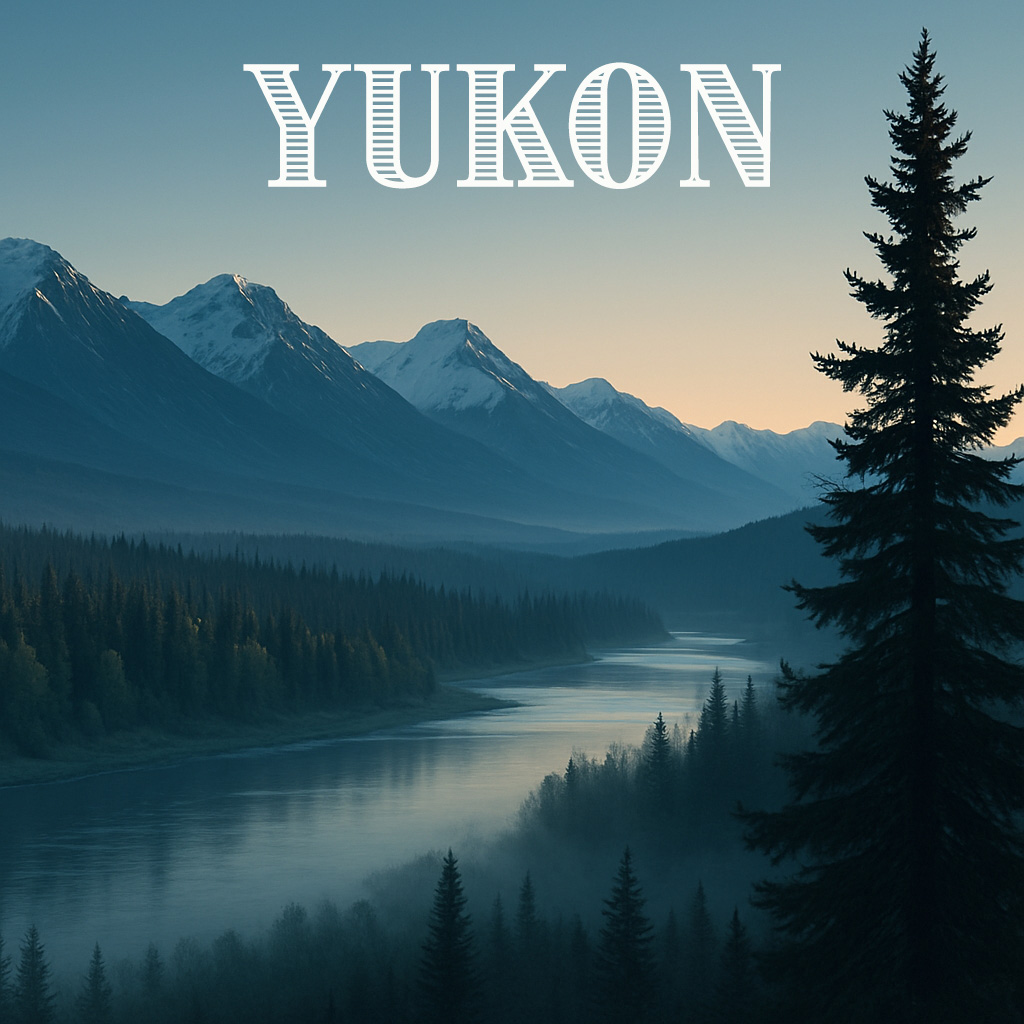
- The landscape is dramatic and varied: rugged mountains (including part of the Rocky / Saint Elias / Coast Mountains ranges), vast wilderness, boreal forests, tundra in the north, many rivers and lakes, and large stretches of sparsely inhabited land.
- The climate is sub-arctic or sub-boreal, with long cold winters, relatively short summers, and significant seasonal variation. The wilderness and natural geography shape lifestyle, economy, and settlement patterns.
Population & Demographics
- Yukon has a small population, making it one of Canada’s least-populated sub-national jurisdictions. The population is concentrated mainly in and around the territorial capital and largest community, Whitehorse.
- Many parts of Yukon are remote, with small communities, Indigenous First Nations settlements, and many uninhabited or lightly inhabited wilderness regions.
- Demographically, the territory includes a mix of Indigenous peoples (First Nations), long-time residents, and newcomers drawn by resource-sector jobs or lifestyle. The small population and remote geography create unique social, economic, and governance dynamics compared to more populous provinces.
🕰️ History & Historical Significance
- Long before European contact, Yukon was home to Indigenous nations (First Nations) with deep traditions connected to the land, rivers, seasonal migrations, hunting, fishing, and trade networks across the mountains and valleys.
- In the late 19th century — notably the Klondike Gold Rush (1896–1899) — Yukon became world-famous: thousands of prospectors rushed to the region seeking gold, dramatically altering settlement patterns, economy, and population.
- The Gold Rush led to establishment of frontier towns, infrastructure (though many later faded), and the beginnings of permanent non-Indigenous settlement.
- Over the 20th century, Yukon’s economy and society evolved: resource extraction (mining, forestry), services, small-town development, and administration became more stable foundations than the boom-and-bust of early gold mining.
- In modern times, Yukon balances mining, resource management, tourism, Indigenous rights and self-governance, environmental protection, and the challenges/opportunities of remote and sub-arctic living.
Yukon’s history — from Indigenous lands, to gold rush frontier, to modern territory — gives it a distinctive identity and heritage among Canadian jurisdictions.
🏛️ Structure & Method of Government
- Yukon is a territory, not a province. Its governmental system is similar to that of provinces but with some distinct features given its size, population, and status.
- It has a territorial legislature (the Yukon Legislative Assembly), whose members are elected to represent electoral districts. The party (or coalition) with confidence of the assembly forms the territorial government; the head of government is the Premier of Yukon.
- The federal government retains certain powers over territories that provinces generally exercise; thus Yukon’s governance involves a partnership between territorial institutions and federal oversight in some areas.
- Local municipalities, Indigenous First Nations governments (where applicable), and community councils also play meaningful roles — especially in remote and rural areas.
- Because of Yukon’s dispersed population, remote communities, and Indigenous presence, governance involves balancing resource development, environmental stewardship, delivery of social services, and respect for Indigenous rights, land claims, and traditional governance.
💼 Economy & Key Economic Factors
Yukon’s economy reflects its geography, natural resources, and small-population context. Key economic factors include:
1. Mining and Mineral Resources
- Yukon has a long mining history (gold from the Klondike Rush, other minerals) and continues to rely on mineral exploration and extraction. Mining remains one of the territory’s economic pillars.
- Mineral resources include precious metals, other minerals — mining projects contribute to employment, export revenue, and regional investment.
2. Natural Resources & Forest / Timber (where applicable)
- Forestry, timber, and resource-based industries contribute to local economies, though environmental balance and sustainable management are critical given sensitive ecosystems.
3. Tourism and Nature-based Economy
- Yukon’s dramatic wilderness, mountains, rivers, and sub-arctic environment make it a draw for tourism: adventure tourism, eco-tourism, northern lights viewing, hiking, wilderness excursions, historic sites (Gold Rush heritage), Indigenous cultural tourism, etc.
- Tourism provides important seasonal and small-business employment, and supports remote communities.
4. Services, Public Administration & Government Employment
- Because of its remote communities and low population density, public services (healthcare, education, territorial administration, social services) play significant economic and employment roles.
- Government remains a major employer relative to population, helping sustain communities where private-sector activity is limited.
5. Challenges & Economic Constraints
- Remoteness, high transportation costs, harsh climate, limited infrastructure, small local markets — all constrain large-scale industrialization or economic diversification.
- Dependence on resource extraction and global commodity cycles (mineral prices) introduces economic volatility.
- Environmental sensitivity, Indigenous land rights, and sustainable development concerns add complexity to resource-based growth.
Overall, Yukon’s economy is relatively modest in scale, heavily influenced by natural resource potentials, and shaped by the trade-offs of remoteness and small population.
📰 Current Affairs & Key Challenges (Mid-2020s)
Here are some of the most relevant ongoing issues and public-policy challenges facing Yukon as of the 2020s:
A. Sustainable Development vs Environmental Conservation
Managing mining, forestry, and resource extraction — while preserving fragile sub-arctic ecosystems, wildlife habitat, water quality, and climate resilience — remains a difficult balance.
Issues around climate change, permafrost, changing wildlife patterns, and environmental impact of resource industries are significant.
B. Indigenous Rights, Land Claims, and Co-Governance
Yukon includes many Indigenous First Nations territories. Ensuring meaningful consultation, land claims settlements, self-governance, cultural preservation, and shared decision-making — especially for resource projects — is a central ongoing concern.
C. Population, Infrastructure & Service Delivery
With a small, dispersed population, many communities face challenges: remote access to health care, education, transport, broadband/internet connectivity, housing, and employment opportunities. Delivering equitable services is logistically and financially demanding.
D. Economic Diversification & Stability
Given global volatility (commodity prices, demand, global market shifts), building a stable and diversified economy beyond mining and seasonal tourism remains a priority — including support for small businesses, renewable energy, sustainable development, and local entrepreneurship.
E. Climate Change, Northern Environment & Resilience
Rising global temperatures, shifting weather patterns, permafrost thaw, changes in wildlife migration and ecosystems — these pose risks to traditional lifestyles, resource sectors, cultural heritage, and community sustainability. Adaptation and resilience planning are increasingly critical.
F. Cultural Preservation & Identity
Balancing modernization, economic development, and global influences with preserving Indigenous heritage, languages, traditional knowledge, and cultural identity — especially for youth and remote communities — is a long-term social challenge.
✅ Why Yukon Matters — Its Role in Canada & the North
- Yukon represents Canada’s northern frontier: a territory where wilderness, Indigenous heritage, and frontier economy blend — crucial for national identity, northern sovereignty, and ecological diversity.
- Its natural resources, while modest in scale compared with larger provinces, contribute to national mining output, mineral export, and resource diversity.
- Yukon offers a living example of remote governance, northern resilience, resource-environment trade-offs, and Indigenous co-existence — themes increasingly central to Canada’s future.
- As environmental concerns and climate change impact northern regions disproportionally, Yukon’s experience may serve as a model for adaptation, conservation, and sustainable living in challenging environments.
📊 Yukon — Data-Rich Profile Sheet
| Attribute / Metric | Value / Description / Notes |
|---|---|
| Official Name | Yukon (territory) |
| Status | Canadian territory (not a province) |
| Land Area | ~ 482,443 km² — among the largest Canadian jurisdictions by land area. |
| Population (2023–2024 estimate) | ~ 45,000 – 45,500 (Yukon is sparsely populated compared with provinces) |
| Population Density | Very low (due to large land area and small population; most people live in a few communities) |
| Capital / Largest Community | Whitehorse — the territorial capital and main urban centre |
| Other Communities & Settlements | Multiple small towns, First Nations communities, remote settlements, rural villages, and historically-based villages across the territory |
| Major Geographic/Environmental Zones | Mountain ranges (part of the Cordillera, including Yukon mountains), boreal forest, sub-arctic tundra (in far north), rivers and lakes, valleys and plateaus — wilderness dominates much of the territory |
| Climate Zones | Sub-arctic / boreal / mountain / northern-climate zones; cold winters, short summers; long daylight variation seasons |
| Key Natural Resources | Minerals (precious and base metals), mining resources, forestry (in some forested zones), freshwater, wilderness — potential for resource extraction, mining, and natural-resource-based industries |
| Economic Base & Key Sectors | Mining and mineral exploration / extraction; small-scale forestry/forest products; public administration and services; tourism and eco-tourism; small business & local services; seasonal economies related to natural environment; resource-dependent activities. |
| Challenges & Structural Characteristics | Remote geography, high cost of living and logistics, harsh climate, limited infrastructure, small local consumer base — all influencing economic diversification and cost of services. |
| Governance Structure | Territorial government: elected legislative assembly; Premier; representation of the Crown via a Commissioner (territorial equivalent) — territorial jurisdiction under Canadian federal-territorial framework. |
| Cultural / Indigenous Presence | Significant Indigenous First Nations presence; many communities belong to various First Nations; Indigenous rights, land claims, traditional resource use and co-governance are central to social and political life. |
| Significance & Role in Canada | Represents Canada’s northern frontier: remote wilderness, northern resource potential, Indigenous heritage, northern sovereignty, ecological diversity, and a unique model of small-population, large-land governance. |
Note on Data Context: Because Yukon has a small population spread over a very large land area, many per-capita or density metrics are not fully indicative of lived reality. Most of the population is concentrated in and around Whitehorse and a few other small settlements; much of the territory remains wilderness or sparsely inhabited.