
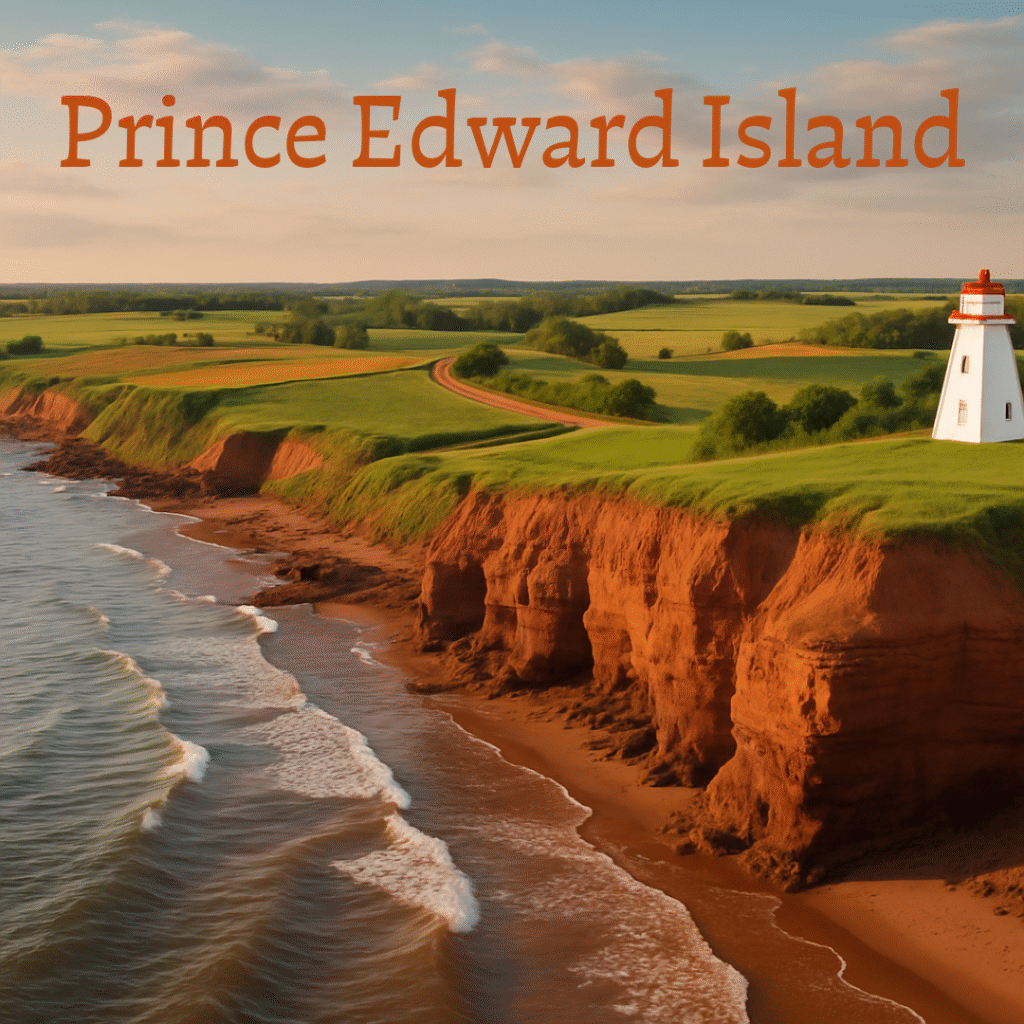
📍 Geography & Population
Location & Geography
- PEI is Canada’s smallest province by land area. It’s an island in the Gulf of St. Lawrence, just off Canada’s Atlantic coast.
- The landscape is characterized by rolling red-soil farmland (notably the distinctive red earth), gently sloping hills, dunes, sandy beaches, coastal inlets, and fertile farmland.
- The island’s modest size, ocean-influenced climate, and seafront geography shape its communities, economy (especially agriculture and fishing), and culture.
Population & Demographics
- PEI has a relatively small population compared with most provinces. (As of the 2021 Census, the population was ~ 154,331 — the smallest among Canadian provinces. While more recent estimates vary, the population remains modest.)
- Because of its small size and population, communities tend to be closer-knit; many residents live in rural or semi-rural settings, while there is a concentration around the provincial capital and largest city, Charlottetown, and other towns.
- The population mix includes people with roots in agriculture, fishing, and long-standing families, as well as newcomers attracted by the island’s quality of life.
🕰️ History & Historical Significance
- Long before European arrival, the lands and waters around PEI were home to Indigenous peoples — especially the Mi’kmaq — who depended on the sea, fishing, and seasonal movements, living in close relationship with land and water.
- European presence began in earnest with French colonization: the island was part of “Acadia.” The French named it Île Saint-Jean. Over time, colonization, settlement, and changing control influenced its demographic and cultural heritage.
- During colonial conflicts between France and Britain in the 18th century, the island changed hands; many of its inhabitants were displaced or affected, including the fate of Acadian settlers.
- Later, British settlement increased — creating a mix of cultures and laying foundations for agriculture, fishing, and community structure based on European-settler models.
- In 1873, PEI joined the Canadian Confederation as Canada’s newest province (the seventh), after initially hesitating — influenced by concerns over debt from building a railway and economic viability. Joining Confederation was meant to ease financial burdens and gain national support.
- Over the 20th century, PEI developed its agricultural identity (especially potatoes), maintained fishing and maritime culture, and gradually developed tourism and services — leveraging its natural beauty, heritage, and community traditions.
PEI’s history — Indigenous heritage, Acadian and European colonization, confederation, and a long agricultural/fishing tradition — shapes its unique identity among Canadian provinces.
🏛️ Government & Political Structure
- As a Canadian province, PEI operates under a parliamentary constitutional monarchy, following the standard provincial structure: a legislature, a Premier, and a Lieutenant Governor representing the Crown.
- The provincial legislature is the Legislative Assembly of Prince Edward Island, made up of elected Members of the Legislative Assembly (MLAs), each representing electoral districts.
- PEI’s relatively small size and population give it a close-knit political context; local issues (farming, fisheries, rural-community support, small towns) often influence provincial politics strongly.
- As part of the federation, residents also vote in federal elections; PEI sends Members of Parliament (MPs) to Canada’s House of Commons and Senators under the federal Senate system.
💼 Economy & Key Economic Factors
Prince Edward Island’s economy is shaped by its size, geography (fertile soil, farmland, coastlines), and its position within Canada’s Atlantic maritime context. Key economic factors:
- Agriculture: Farming is a foundational economic activity. PEI is especially known for its potato production, among the largest in Canada. The fertile red-sand soils and moderate climate support not only potatoes but other crops and livestock. This agricultural base supports rural communities, food processing, exports, and local consumption.
- Fisheries and Aquaculture: Given its island nature, fishing, shellfish harvesting, and marine harvest (including lobster, crab, other seafood) are historically important for coastal communities. The sea remains central to local livelihood and identity.
- Tourism and Heritage / Recreation: PEI’s scenic landscapes, pastoral farmland, coastal beaches, lighthouses, warm summers, and cultural heritage (settler history, maritime tradition, Indigenous history) draws tourists. Tourism supports hospitality, small business, crafts, arts — helping diversify beyond just agriculture and fishing.
- Small-scale Industry and Local Services: Given its small population, many local services, small businesses, food processing, services tied to agriculture/fishing/tourism, and local retail/commerce provide employment and sustain communities.
- Community & Rural Economy: Because PEI is largely rural or small-town, community-based economies, local trade, family farms, and small-business networks remain important. This rural-oriented economy gives PEI a character different from large urbanized provinces.
Because of its scale and economy, PEI’s economic strengths depend heavily on natural resources (land and sea), sustainable management, community resilience, and diversification via tourism and services.
📰 Current Affairs & Key Issues (Mid-2020s)
Here are some of the important issues, debates, and challenges shaping Prince Edward Island today:
- Agricultural sustainability & land use — With heavy reliance on farming (especially potatoes), concerns about soil health, sustainable farming practices, crop diversification, climate change impacts, and land-use pressures (development vs farmland preservation) are important.
- Fisheries & Marine Resource Management — Maintaining sustainable fisheries, adapting to changing marine ecosystems, balancing commercial harvest with conservation, and supporting coastal communities remain ongoing challenges.
- Tourism vs Community & Environment Balance — As tourism grows, balancing visitor influx with preservation of local heritage, environment, community character, and sustainable development is a key challenge.
- Rural Communities & Youth Retention — With small population and rural settings, PEI may face issues of out-migration, youth leaving for larger cities, and sustaining small communities in the face of economic pressures. Retaining young people and supporting rural livelihoods is important.
- Housing, Cost of Living & Infrastructure — As tourism and migration place pressure on housing and services, ensuring affordable housing, infrastructure (transport, health, services) for residents — both long-term and seasonal — can be a concern.
- Climate Change & Coastal / Environmental Vulnerability — As an island province, PEI is vulnerable to sea-level rise, coastal erosion, changing weather patterns, and ecological shifts — affecting agriculture, fisheries, coastlines, and community safety.
- Cultural Heritage & Indigenous Relations — Recognizing and honouring the Indigenous heritage (especially of the Mi’kmaq), ensuring reconciliation, protecting historical sites, and integrating Indigenous voices in governance and resource management remain important social-policy priorities.
✅ Significance of Prince Edward Island — Its Role in Canada
- PEI represents Canada’s small-province, island-and-maritime heritage — a contrast to large continental provinces. Its rural character, farming and fishing traditions, and close-knit communities offer a different slice of Canadian life that highlights regional diversity.
- The province’s agricultural output (especially potatoes), seafood, and tourism contribute to Canada’s food production, export capacity, and cultural tourism sector.
- As a small, community-oriented province, PEI offers a model of sustainable rural living, balanced natural-resource use, and community-based economy — relevant to larger debates about sustainability, environment, rural development, and heritage preservation.
- Its history — Indigenous heritage, colonial and Acadian history, confederation — plus its ongoing efforts to balance modern economy with tradition, make PEI important in understanding Canada’s diversity, regional identities, and social fabric.
🕰️ Prince Edward Island — Major Historical & Political Timeline
Pre-Contact – 1600s
- Thousands of years ago — Mi’kmaq people inhabit Epekwitk (“lying in the water”), relying on fishing, hunting, seasonal migration, and deep knowledge of island ecosystems.
- Mi’kmaq territory forms part of the wider Wabanaki Confederacy.
1600s – Early European Settlement
- 1600s — French explorers arrive; the island becomes part of Acadia.
- Named Île Saint-Jean; first European settlements grow slowly.
- Mi’kmaq and French coexist and trade, though colonial conflicts affect the region.
1713 – Treaty of Utrecht
- France cedes parts of Acadia to Britain, but Île Saint-Jean remains French.
- French settlement increases; agricultural communities and fishing operations expand.
1758 – Expulsion of the Acadians
- As part of the Seven Years’ War, the British seize the island.
- Many Acadians are forcibly deported; some escape or later return.
- This event deeply shapes cultural memory and heritage on the island.
1769 – PEI Becomes a Separate British Colony
- The island becomes a formal colony under British rule.
- Land is divided among absentee landlords (the “land lottery system”), causing long-term political tension for decades.
1800s – Land Reform & Local Government
- Island residents push back against absentee landlord system.
- Gradual reforms lead to more local control, tenant rights, and eventual buyouts of large estates.
- Agriculture—especially potatoes—becomes central to rural life.
1864 – Charlottetown Conference
- Although PEI does not join Confederation at first, it hosts the Charlottetown Conference, where the idea of a united Canada is born.
- PEI is often called the “Birthplace of Confederation.”
1873 – Joining Canada
- Facing financial trouble from railway construction, PEI joins Confederation as Canada’s seventh province.
- The federal government agrees to assume railway debt and provide ferry connections.
1900s – Modernization & Rural Development
- Expansion of agriculture, fishing industries, and small-scale manufacturing.
- Seasonal tourism begins to flourish, supported by natural scenery and heritage.
1997 – Confederation Bridge Opens
- The 12.9-km bridge links PEI to New Brunswick, transforming transportation, tourism, logistics, and business.
2000s–2020s
- Continued diversification into biotech, food processing, and renewable energy.
- Coastal erosion and climate change become central policy concerns.
- Population grows slowly but steadily through immigration and interprovincial movement.
📊 Prince Edward Island — Data-Rich Profile Sheet
| Category | Details |
|---|---|
| Province Name | Prince Edward Island (PEI) |
| Joined Confederation | July 1, 1873 |
| Indigenous Peoples | Mi’kmaq (Epekwitk) |
| Capital & Largest City | Charlottetown |
| Other Major Communities | Summerside, Stratford, Cornwall |
| Land Area | 5,660 km² (smallest in Canada) |
| Population (2024 est.) | ~175,000 (approx.) |
| Population Density | One of the highest in Canada due to small land area |
| Geography | Island province with red-sand beaches, rolling farmland, cliffs, bays, dunes, and low hills |
| Climate | Maritime climate — warm summers, cool winters, strong seasonal tourism |
| Languages | English (majority), French (historical Acadian communities), Mi’kmaq |
| Time Zone | Atlantic Time (UTC −4 / −3 DST) |
🏛️ Government & Political Structure
| Category | Details |
|---|---|
| System | Parliamentary constitutional monarchy |
| Legislature | Legislative Assembly of Prince Edward Island |
| Head of Government | Premier |
| Head of State (Provincial) | Lieutenant Governor |
| Federal Representation | 4 MPs, 4 Senators |
| Municipal Structure | Cities, towns, rural municipalities — many small, community-based administrations |
💼 Economic Profile & Sector Breakdown
1. Agriculture (Flagship Sector)
- PEI is world-renowned for potatoes — its largest crop and export.
- Also produces carrots, grains, berries, beef, dairy.
- Rich red soil and moderate climate support agricultural diversity.
- Food processing (fries, snacks, produce) is a major employer.
2. Fisheries & Aquaculture
- Lobster, mussels, oysters, crab, herring.
- Mussel farming is a global success story; PEI is Canada’s largest mussel producer.
- Coastal fishing communities remain culturally central.
3. Tourism
- Driven by beaches, coastal scenery, heritage, golf courses, and “Anne of Green Gables” cultural tourism.
- Seasonal population surges in summer.
- Key economic driver for small businesses and hospitality.
4. Bioscience & Innovation
- A growing biotech and pharmaceutical sector concentrated around Charlottetown.
- Supported by research institutions and specialized manufacturing.
5. Renewable Energy & Environment
- Investments in wind energy and climate resilience.
- Environmental monitoring and coastal science are increasingly important.
6. Public Sector & Services
- Education, healthcare, and local government play a major role in employment due to the province’s scale.
📰 Current Affairs & Strategic Issues (Mid-2020s)
1. Housing & Population Growth
- Rising population creates housing pressures, particularly in Charlottetown.
- Affordability and availability are key policy priorities.
2. Climate Change & Coastal Erosion
- PEI is highly vulnerable due to sandy soils, cliffs, and low elevation.
- Storm surges and rising seas threaten infrastructure and farmland.
3. Agricultural Sustainability
- Concerns about soil quality, crop rotation, and nitrate levels in groundwater.
- Push toward greener and more diversified agriculture.
4. Fisheries Management
- Lobster stocks, aquaculture health, and marine conservation remain vital concerns.
- Climate shifts affect species distribution and fishing seasons.
5. Tourism Balance
- Need to maintain sustainable tourism while avoiding overreliance on seasonal income.
- Infrastructure upgrades are ongoing.
6. Rural Community Stability
- Many small communities struggle with aging populations and youth out-migration.
- Investments in broadband, healthcare access, and transportation are priorities.