
📍 Geography & Population
Location & Geography
- Manitoba is located in the central part of Canada: it lies between the provinces of Saskatchewan (to the west) and Ontario (to the east), stretching from the US border in the south to the Hudson Bay in the north.
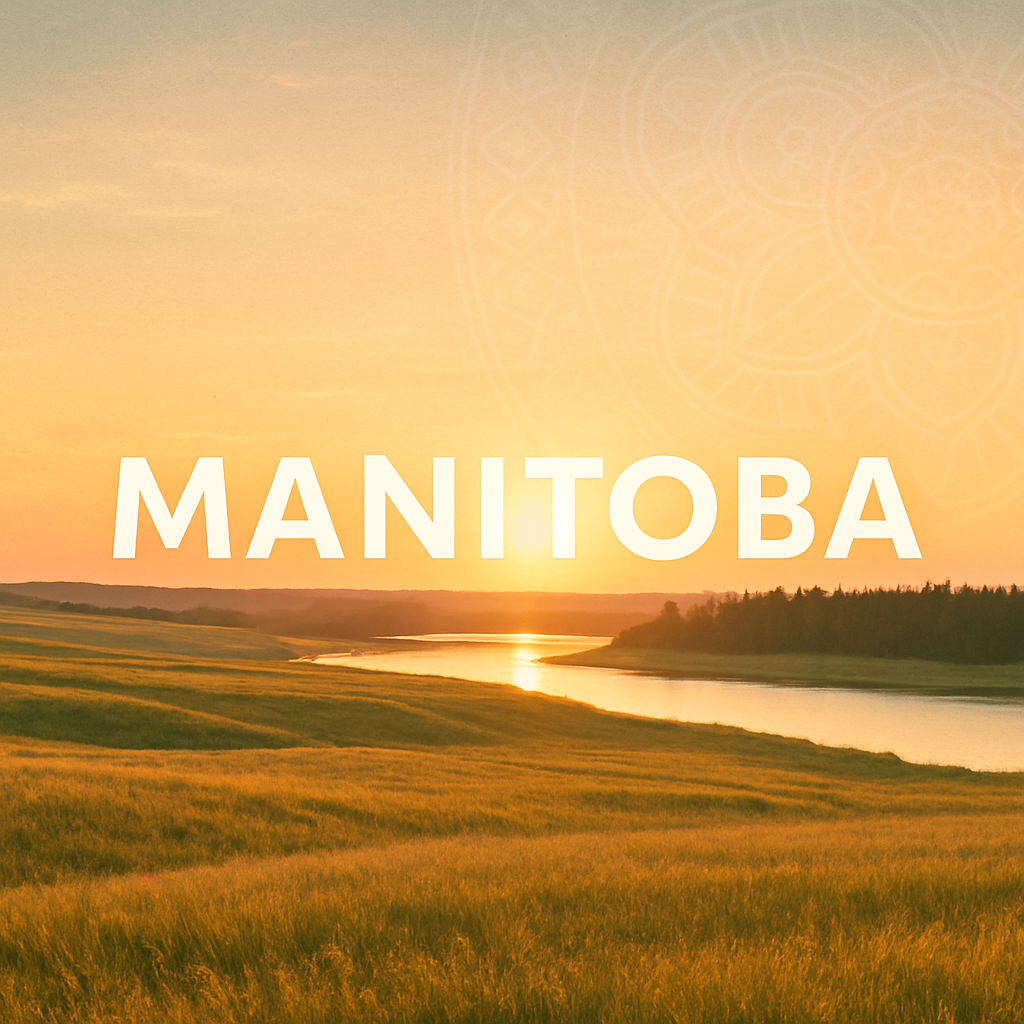
- Its geography is diverse: southern Manitoba is largely prairie and farmland; central and northern Manitoba includes boreal forest, lakes, rivers — including parts of the Canadian Shield; and the far north reaches into subarctic and tundra-influenced zones.
- One of its major geographic features is Lake Winnipeg, one of the largest lakes in Canada, which plays a big role in climate, ecology, and economy for many Manitobans.
Population & Demographics
- Manitoba has a population of around 1.4 million to 1.5 million (exact figures vary depending on the census or estimate — it is among the mid-sized Canadian provinces by population).
- The population is concentrated in the south, especially around the provincial capital and largest city, Winnipeg, which is the main urban, cultural, and economic hub of the province.
- Outside Winnipeg there are smaller cities, towns, rural communities — including many Indigenous and Métis communities — especially in northern or remote regions.
- Demographically, Manitoba has a more youthful population compared with some other provinces, and a relatively high rate of Indigenous population percentage, which shapes its culture, politics, and social dynamics.
🕰️ History & Historical Significance
- Indigenous peoples (First Nations and Métis) have lived on the land now known as Manitoba for thousands of years — relying on rivers, lakes, hunting, fishing, and trade networks.
- During the fur-trade era, the area became a hub of trade and contact between Indigenous peoples and European traders, particularly through trading posts, rivers, and trade routes.
- With European settlement and immigration in the 19th and early 20th century, southern Manitoba’s fertile prairie land attracted settlers — agriculture became a foundational economic base.
- Over time, Manitoba developed as a province balancing prairie-agriculture, resource and wilderness in the North, and urban growth around Winnipeg, giving it both rural and urban character.
- Manitoba’s dual heritage (Indigenous / Métis, settlers) has influenced its social, cultural, and political life, contributing to a diverse population with distinct communities, languages, and traditions.
🏛️ Government & Political Structure
- As a Canadian province, Manitoba operates under the federal parliamentary system. It has its own provincial government responsible for areas such as education, health care, provincial justice, resource management (forests, water, mining), infrastructure, etc.
- The provincial legislature and political institutions represent Manitobans; decisions about provincial laws, budgets, resource use, social services, and regional development are made at this provincial level, in addition to the federal government’s role.
- Because Manitoba includes many Indigenous and Métis communities — some in remote or northern regions — provincial governance often intersects with Indigenous rights, land claims, resource policy, and social justice issues.
💼 Economy & Key Economic Factors
Manitoba’s economy is more diversified than a simple “prairie agriculture” stereotype might imply. Some of its important economic drivers:
- Agriculture & Agri-food: In the south — especially the prairie/farmland area — agriculture remains a strong sector. Grain, cereals, oilseeds, livestock and other farm products form a backbone for rural Manitoba.
- Resource & Natural-Resource Economy: In forested and northern areas, forestry, fishing, freshwater resources, and mining / resource extraction (in certain zones) contribute to the economy. The presence of large lakes and waterways supports fishing, transport, and resource industries.
- Manufacturing & Industry: Winnipeg and surrounding regions host manufacturing, processing (food, goods), transport, services — providing jobs, industrial output, and economic diversification beyond agriculture.
- Services, Education, Public Sector, and Trade: As the main city, Winnipeg supports government, education, healthcare, trade, services — making the urban center critical to provincial GDP and living standards.
- Transportation & Logistics: Owing to its central location in Canada, Manitoba plays a role in trade corridors, rail/road transport, distribution. Its geography and infrastructure help link east–west and north–south trade within Canada and beyond.
This diversity — agriculture, resources, services, manufacturing, transport — helps Manitoba buffer economic fluctuations, and supports both rural and urban populations.
📰 Current Affairs & Key Issues (as of mid-2020s)
Here are some of the key issues and ongoing debates relevant to Manitoba today:
Indigenous and Métis Rights, Land & Reconciliation
Given the sizable Indigenous and Métis population, issues around reconciliation, land claims, rights to natural resources (water, forests, fishing), self-governance, and social services remain important. Ensuring equitable access to education, healthcare, infrastructure for remote / northern communities is an ongoing challenge.
Rural vs Urban Balance and Regional Inequality
Manitoba spans modern urban areas and remote northern zones. Differences in economic opportunity, access to services, infrastructure, and living conditions between Winnipeg (urban) and rural or northern areas remain a structural challenge.
Economic Diversification and Resilience
As agriculture and resource sectors face global price fluctuations, climate change, and environmental pressures, Manitoba works to maintain economic stability through diversification — supporting manufacturing, services, trade, and urban economic development.
Environmental Management and Freshwater / Waterway Protection
With vast lakes, rivers, and freshwater resources, Manitoba must balance development, resource use (forestry, mining, agriculture) with environmental protection, water quality, ecosystem health, and sustainable use of natural resources.
Immigration, Growth & Urban Services
Winnipeg and some growing regions attract newcomers — immigrants, workers — which drives demand for housing, services, education, and infrastructure. Managing urban growth, integration, affordable housing, and social services is a recurring topic.
Climate Change and Northern / Remote Impacts
Northern and remote communities can be disproportionately affected by climate change, changes in resource availability, environmental shifts, and access challenges — raising questions about adaptation, support, and long-term planning in those regions.
✅ Significance of Manitoba — Its Role in Canada
- Manitoba acts as a bridge between western and eastern Canada — geographically central, linking prairie economies with trade corridors, east–west transport, and national infrastructure.
- Its mix of agriculture, natural resources, manufacturing, services, and trade provides economic resilience, diversity, and a balance between rural and urban livelihoods.
- The presence of a significant Indigenous and Métis population — and Manitoba’s role in reconciliation, Indigenous rights, and multiculturalism — positions it as an important province for social justice, cultural heritage, and Canada’s evolving identity.
- As a province with varied geography — from prairie farmland to forest, fresh water lakes to northern wilderness — Manitoba reflects many of Canada’s core ecological and geographic features, making it representative of the country’s environmental diversity and natural resource opportunities.
🕰️ A Detailed Timeline — Manitoba’s Major Historical & Political Events
| Year / Period | Event / Significance |
|---|---|
| Pre-contact (millennia before European arrival) | The region now called Manitoba was home to many Indigenous peoples — including Cree, Ojibwe, Dene, Métis, and Ininiw — with complex social, trade, and governance systems, navigating lakes, rivers, plains and boreal forests. |
| 1670 | Establishment of the Hudson’s Bay Company (HBC), which claimed Rupert’s Land — including much of present-day Manitoba — marking the beginning of large-scale fur trade and European-Indigenous economic relations in the region. |
| 1812–1820s | Competition between HBC and the North West Company intensifies fur trade; Métis communities grow around Red River, mixed European-Indigenous cultures begin forming. |
| 1869–1870 | Red River Resistance under Louis Riel; Métis and local settlers resist transfer of Rupert’s Land to Canadian government without protections — leading to provisional government and negotiations. |
| 1870 | Creation of the Province of Manitoba via the Manitoba Act on July 15, 1870. Manitoba enters Confederation as Canada’s fifth province (originally small “postage-stamp” size around the Red River area). |
| Late 1800s | Waves of European immigration (Ukrainian, Mennonite, German, Scandinavian, etc.) settle the prairie lands; agriculture and settlement expand, transforming the Red River settlement into a growing agricultural province. |
| 1880s–1890s | Construction of railways, expansion of farmland, establishment of small towns — Manitoba begins to take shape as a prairie-agriculture province. |
| Early–Mid 1900s | Winnipeg becomes a major rail, trade, and transportation hub; growth in agriculture, grain exports; growth of manufacturing, services, and urbanization. |
| 1940s–1970s | Post-war growth accelerates; expansion in manufacturing, transportation, public services; growth of population; gradual development in northern and remote resource zones (forestry, mining, hydro). |
| Late 20th century | Diversification beyond agriculture — growth in services, manufacturing, transportation/ logistics; recognition of Indigenous and Métis rights; evolving land/resource policies; growing urbanization. |
| 2000s–2020s | Manitoba develops as a mixed economy with agriculture, resource extraction, manufacturing, services, trade — balancing prairie south with forested north and freshwater systems. Increasing attention to Indigenous issues, reconciliation, northern infrastructure, and environmental sustainability. |
| Recent (2020s) | Population growth through immigration and internal migration; urban growth around Winnipeg; ongoing negotiations and policies around Indigenous rights, land use, resource development, environmental protection, and rural/remote community support. |
📊 Manitoba — Data-Rich Profile Sheet (Reference Snapshot)
Key Facts (as of mid-2020s estimates):
| Attribute / Metric | Approximate Value / Description |
|---|---|
| Population (2024 est.) | ~1,393,000 to 1,400,000 (Manitoba is one of Canada’s mid-sized provinces by population) |
| Land Area | ~649,950 km² — includes prairie, forest, shield, lakes, rivers, and northern wilderness |
| Capital / Largest City | Winnipeg — capital, major economic, cultural & transportation hub |
| Other Significant Cities / Centres | Brandon; Steinbach; Thompson; Portage la Prairie; Selkirk; The Pas; rural and Indigenous communities across north/central Manitoba |
| Geographic Zones | Southern prairie plains (agriculture), central boreal forest & lake area, northern subarctic / shield / remote wilderness & lakes, major freshwater systems (e.g. Lake Winnipeg), rivers (Red River, Saskatchewan River, etc.) |
| Economic Structure (Major Sectors) | Agriculture & agri-food; natural resources (forestry, mining, freshwater fisheries); manufacturing & processing; transportation & logistics; services / public sector; trade / exports |
| Natural Resources | Prairie farmland, freshwater lakes/rivers, forests, forest products, mineral reserves in some zones, freshwater fisheries; abundant freshwater and biodiversity — valuable for ecology, recreation, resource use |
| Demographics & Social Composition | Significant Indigenous and Métis population; diverse heritage due to historical immigration (European settlers, later immigrants), rural and urban mix, younger population on average vs some provinces |
| Economy & Trade Role | As a central-Canada province bridging east–west trade, Manitoba is important to cross-country rail/road arteries; agriculture exports, resource outputs, and urban manufacturing/services contribute to national supply chains |
🔎 Economic Sector Breakdown (By Key Strengths / Activities)
- Agriculture & Agri-Food: Grains (wheat, canola), oilseeds, livestock, dairy, mixed farming in southern Manitoba — foundational economic base for rural communities and export trade.
- Resource Economy: Forest product harvesting, timber, freshwater fisheries, mining (in certain zones), northern resource development.
- Manufacturing & Processing: Food processing, goods manufacturing, processing of farm/forest outputs, value-added manufacturing.
- Transportation, Logistics & Trade: Winnipeg’s central location makes it a hub for rail, road, and supply-chain distribution, linking western and eastern Canada, supporting exports/imports, storage, distribution.
- Services & Public Sector: Government services, education, health care, urban services in Winnipeg and surrounding areas — major employer and economic support.
- Freshwater & Environmental / Tourism Potential: Lakes, rivers, forests — supporting recreation, tourism, freshwater fisheries, ecological services; opportunities for sustainable development.