
📍 Geography & Population
Location & Key Geographic Features
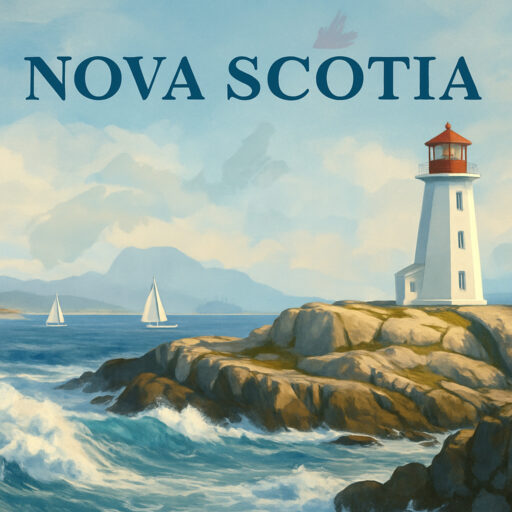
- Nova Scotia is one of Canada’s Atlantic provinces, largely surrounded by water. It is a peninsula (plus Cape Breton Island) projecting into the Atlantic Ocean, which gives it a long coastline and many bays, inlets, and natural harbours.
- Its geography includes coastal lowlands, rocky shorelines, forested highlands (especially in Cape Breton), and a maritime climate influenced by the Atlantic. Its extensive coastline and maritime environment have shaped much of its culture, economy, and settlement patterns.
- The province’s maritime geography affects climate, livelihoods (fishing, shipping), and regional identity.
Population and Demographics
- Nova Scotia has a population on the order of about 1 million (more precisely, just over one million people; exact numbers vary by census and estimates). This makes it one of Canada’s smaller provinces by population.
- A significant portion of Nova Scotians live in or around the provincial capital and largest city, Halifax, Nova Scotia — the major urban centre that anchors much of the province’s economic, cultural, and administrative activity.
- The rest of the population is more thinly spread across smaller towns, rural areas, coastal fishing villages, and more remote communities (including on Cape Breton Island and in more forested or coastal zones).
- Because of its smaller population and more rural/remote areas, Nova Scotia has a different demographic and social profile than Canada’s large provinces: more close-knit communities, reliance on traditional industries in many parts, and a blend of urban and rural lifestyles.
🕰️ History & Historical Significance
Nova Scotia has a long and layered history that has shaped its identity, culture, and institutions:
- Originally the lands of Indigenous peoples (Mi’kmaq and other First Nations), long before European arrival. Indigenous peoples lived, fished, and governed themselves in these lands and waters.
- With European colonization and settlement, Nova Scotia became one of the early focal points of European — particularly British and French — colonial competition in North America. Over centuries, trade, fishing, settlement, and strategic importance shaped its growth.
- The province played an important role in Atlantic-Canada history: as a maritime hub, in fisheries, shipbuilding, shipping, transatlantic trade, and as a gateway to the Americas. Its coastal communities, harbours, and ports have been central to its livelihood and connection to the wider world.
- Over time, Nova Scotia’s identity blended maritime tradition, colonial legacy (both British and earlier European), rural & coastal community life, and later, modern Canadian provincial integration.
Because of its history, geography, and culture, Nova Scotia retains a distinctive Atlantic / maritime Canadian identity — different in many ways from central Canada or the Prairie provinces.
🏛️ Government & Political Structure
- Nova Scotia is a province of Canada and thus part of the federal structure. As such it has its own provincial government responsible for matters within provincial jurisdiction (e.g. health care, education, provincial infrastructure, municipal affairs, natural resources within its boundaries, local justice, etc.).
- The legislature — the provincial parliament or assembly — represents its citizens and makes laws for the province. In Nova Scotia the legislative body is the Nova Scotia House of Assembly (the oldest in Canada). The province’s political institutions follow the parliamentary model, similar to other Canadian provinces: elected representatives, a Premier (head of government), and a Lieutenant Governor representing the Crown (symbolic/head-of-state role provincially).
- The capital and seat of government is Halifax, which concentrates many administrative, political, and judicial functions for the province.
- Residents of Nova Scotia also vote in federal Canadian elections for representation in the national parliament (House of Commons and Senate), as with all provinces.
This structure gives Nova Scotia autonomy over provincial matters while remaining part of the Canadian federation.
💼 Economy & Key Economic Activities
Nova Scotia’s economy is shaped by its maritime geography, natural resources, history, and evolving modern industries. Some significant economic factors:
- Fisheries and Fishing Industry: Given its extensive coastline and proximity to rich Atlantic fisheries, fishing (and related seafood, fish processing) historically and currently plays a major role in many coastal and rural communities. This includes small-scale fisheries, lobster, shellfish, groundfish (though subject to regulation and ecosystem changes), and marine harvests.
- Shipping, Ports, and Trade: Major ports — especially Halifax — serve as hubs for shipping, trade, imports and exports, and maritime transport. The port infrastructure supports not only local commerce but cargo, container shipping, and connections to Atlantic and global trade routes.
- Shipbuilding and Marine Services: Given its coastal heritage, shipbuilding, repair, marine logistics, and services tied to shipping and maritime industries have been important to Nova Scotia’s economy.
- Tourism and Natural / Cultural Heritage: Nova Scotia’s scenic coastline, historic towns, maritime culture, lighthouses, national parks, coastal landscapes, and cultural heritage draw tourists. Tourism contributes significantly, especially in coastal and rural areas, promoting hospitality, recreation, fishing-heritage tourism, and cultural tourism.
- Natural Resources & Forestry: In forested and rural areas, forestry, timber, related resource industries (wood products, pulp and paper where applicable), and resource-based employment contribute to local economies.
- Public Services, Education, Health, Government Employment: As with many provinces with smaller populations and dispersed communities, public sector, health care, education, and government services remain important employers, especially outside the main urban centre.
- Emerging Sectors and Diversification: Over time, like many regions, Nova Scotia has increasingly diversified: including service industries, small business, renewable energy (in some areas), technology and education (especially centered in Halifax), and efforts to modernize economy beyond traditional maritime and resource sectors.
Because of its size and population, Nova Scotia’s economy combines traditional strengths with gradual modernization and diversification. Its maritime identity remains central.
📰 Current Affairs & Key Issues (as of mid-2020s)
Here are some of the important issues, challenges, and public-policy debates facing Nova Scotia now:
- Economic Transition & Diversification: As traditional industries (fisheries, forestry, shipping) face global competition, regulatory constraints, and changing environmental conditions, Nova Scotia must continue diversifying its economy — balancing tradition and modern economic needs.
- Coastal Community Sustainability: Many small coastal towns and fishing villages face challenges: youth out-migration, economic uncertainty, resource stock fluctuations, environmental changes (climate change, ocean conditions), and the need for sustainable fisheries. Supporting these communities while adapting to modern realities is an ongoing task.
- Infrastructure and Connectivity: Ensuring that rural and remote areas — especially in coastal or less-densely populated regions — have access to modern services, transport, internet/broadband, health care, and economic opportunity. Infrastructure maintenance and investment remain important, especially given dispersed settlement.
- Urban Growth and Housing in Halifax: As Halifax grows as the major urban, economic, and cultural hub, issues around housing supply, affordability, urban planning, social services, and transit become more salient. Urban-rural divide and equitable development are among the concerns.
- Environmental and Climate Concerns: Being a maritime province, Nova Scotia is exposed to climate change effects: rising sea levels, coastal erosion, extreme weather, changing marine ecosystems — which threaten fisheries, coastal infrastructure, and traditional ways of life. Sustainable environmental and resource policies are increasingly important.
- Demographic Shifts and Population Retention: With a relatively small population and some rural areas losing population or seeing youth migration to urban centres or outside the province, there is a need to retain and attract residents — via economic opportunity, quality of life, services, and modern infrastructure.
- Balancing Heritage / Culture with Modernization: Preserving maritime, coastal, rural, and cultural heritage (community identity, local traditions, small-town life) while embracing modernization, economic change, and new generations is a persistent balancing act for Nova Scotia.
✅ Significance of Nova Scotia — Its Place in Canada
Nova Scotia plays a distinct and important role within Canada:
- As one of the Atlantic provinces, it embodies Canada’s maritime heritage — reminding Canadians of the nation’s connection to the sea, fishing, shipping, and Atlantic-coast culture.
- Its mix of small coastal/rural communities and a central urban hub (Halifax) shows a different model of Canadian living compared to large, densely populated provinces — offering diversity in lifestyle, economy, and community structures.
- Nova Scotia highlights the challenges many smaller or coastal regions face globally: economic transitions, environmental pressures, balancing tradition and modernization, and population retention — offering lessons in resilience, adaptation, and balance.
- Its cultural, historical, and economic contributions (fisheries, shipping, trade, maritime industries, tourism, heritage) contribute to Canada’s broader identity and economy, especially on the Atlantic coast.
📜 1. Nova Scotia — Detailed Historical & Political Timeline
Pre-1600s — Indigenous Foundations
- Mi’kmaq Nation inhabits the region for thousands of years.
- Complex systems of governance, trade, spiritual life, and seasonal coastal–inland patterns shape early Nova Scotia.
1600s — Early European Contact & French Settlement
- 1605: Port Royal is founded by French settlers — one of the earliest European settlements in North America.
- Region forms part of Acadia, contested between France and England repeatedly.
- Mi’kmaq treaties and alliances become crucial during early conflicts.
1700s — Imperial Conflict & British Ascendancy
- 1713: Treaty of Utrecht — France cedes mainland Nova Scotia to Britain.
- 1749: Halifax is founded as a British military and administrative centre.
- 1755–1764: Acadian Expulsion (Le Grand Dérangement). Thousands of Acadians are deported by British authorities.
- Late 1700s: Arrival of Loyalists from the American Revolution strengthens English-speaking population.
- 1784: Cape Breton is briefly separated as its own colony; later reunified.
1800s — Maritime Prosperity & Confederation
- Early 1800s: Major shipbuilding, fishing, and maritime trade centre; the “Golden Age of Sail.”
- 1836–1848: Nova Scotia leads the push for responsible government under Joseph Howe.
- 1867: Nova Scotia becomes one of the four founding provinces of the Dominion of Canada — though many residents initially oppose Confederation.
1900s — Modernization & Economic Shifts
- Early 20th century: Industrialization grows in steel, coal, and manufacturing.
- 1917: Halifax Explosion, one of the largest non-nuclear explosions in history, devastates the city.
- Mid-Century: Collapse of traditional industries brings economic diversification and federal support programs.
- 1990s: Cod-moratorium era reshapes coastal communities as commercial fishing declines.
2000s–2020s — Contemporary Era
- Growth of Halifax as Atlantic Canada’s economic, cultural, and educational centre.
- Expansion of tourism, arts, tech, health care, and service industries.
- Climate change, fisheries management, and coastal adaptation emerge as major policy issues.
- Population slowly grows through interprovincial migration and international arrivals.
📊 2. Nova Scotia — Comprehensive Profile Sheet (Quick Facts)
| Category | Details |
|---|---|
| Official Name | Province of Nova Scotia |
| Capital | Halifax |
| Largest City | Halifax Regional Municipality (HRM) |
| Land Area | ~55,000 km² (second smallest province, but heavily coastal) |
| Coastline Length | Over 13,000 km including inlets & islands |
| Population (2025 est.) | ~1,050,000 |
| Population Density | Higher than most Atlantic provinces, concentrated around Halifax |
| Main Regions | Halifax, Annapolis Valley, South Shore, Fundy Shore, Eastern Shore, Cape Breton |
| Official Language | English (French minority communities present) |
| Indigenous Peoples | Mi’kmaq Nation across the province |
| Climate | Maritime — cool winters, mild summers, strong ocean influence |
| Time Zone | Atlantic Time (UTC-4 / UTC-3 in summer) |
💼 3. Economic Sector Breakdown (Overview Table)
| Sector | Importance | Notes |
|---|---|---|
| Fisheries / Aquaculture | High | Lobster, scallops, crab major exports; key employer in rural/coastal areas |
| Port, Shipping & Marine Services | High | Port of Halifax is one of Canada’s busiest Atlantic ports |
| Shipbuilding | High | Irving Shipbuilding major contributor; naval contracts significant |
| Tourism | Medium-High | Strong seasonal economy: coastline, culture, national parks, seafood, heritage |
| Forestry & Natural Resources | Medium | Timber, pulp, and related industries remain active but smaller than in past |
| Public Sector & Health Care | High | Major employer, especially outside Halifax |
| Education & Research | Medium-High | Universities in Halifax (Dalhousie, Saint Mary’s) drive innovation |
| Technology & Services | Growing | Rapid growth in fintech, gaming, ocean-tech, start-ups, and digital services |
| Agriculture | Medium | Annapolis Valley (fruit, berries, wine, farming) |
📰 4. Current Affairs & Key Issues in Nova Scotia (2020s)
A. Housing Affordability & Halifax Growth
- Halifax faces pressure from rapid population growth and limited housing supply.
- Rent increases, limited affordable housing, and zoning debates dominate provincial politics.
B. Coastal Erosion & Climate Adaptation
- Rising sea levels and stronger storms threaten roads, homes, harbours, and dykes.
- Cape Breton and the South Shore face acute coastal vulnerability.
C. Fisheries Sustainability & Regulation
- Balancing commercial, Indigenous treaty-rights fisheries, federal regulations, and conservation.
- Lobster and snow crab remain strong but ocean temperatures and stock pressures pose risks.
D. Health Care Staffing & Wait Times
- Shortages of family doctors and nurses, long ER wait times, and rural-access challenges are recurring issues.
E. Rural Economic Development
- Coastal and inland towns struggle with:
- youth out-migration
- seasonal employment
- limited broadband
- declining traditional industries
- Efforts include rural innovation zones, tourism promotion, and infrastructure investment.
F. Environmental Stewardship: Forests, Mines, Wind, and Offshore Energy
- Increasing debates on logging practices, sustainable forestry, and land use.
- Interest in offshore wind projects and clean energy expansion (hydrogen, wind farms).
G. Immigration & Population Strategy
- Nova Scotia welcomes thousands of newcomers each year to offset aging population trends.
- Settlement services, French-language education access, and rural retention strategies are ongoing.
🌊 5. Significance of Nova Scotia in Canada
Nova Scotia’s role includes:
- Cultural and historical importance as one of the earliest areas settled in Canada.
- Key maritime hub linking Canada to Atlantic & international shipping networks.
- Symbol of Canada’s coastal heritage, marine economy, and Atlantic regional identity.
- Increasing contributor to Canada’s ocean-tech, clean energy, and research sectors.