
Learn about everything Canadian. Choose a province or territory from the menu, or read on to start your journey.
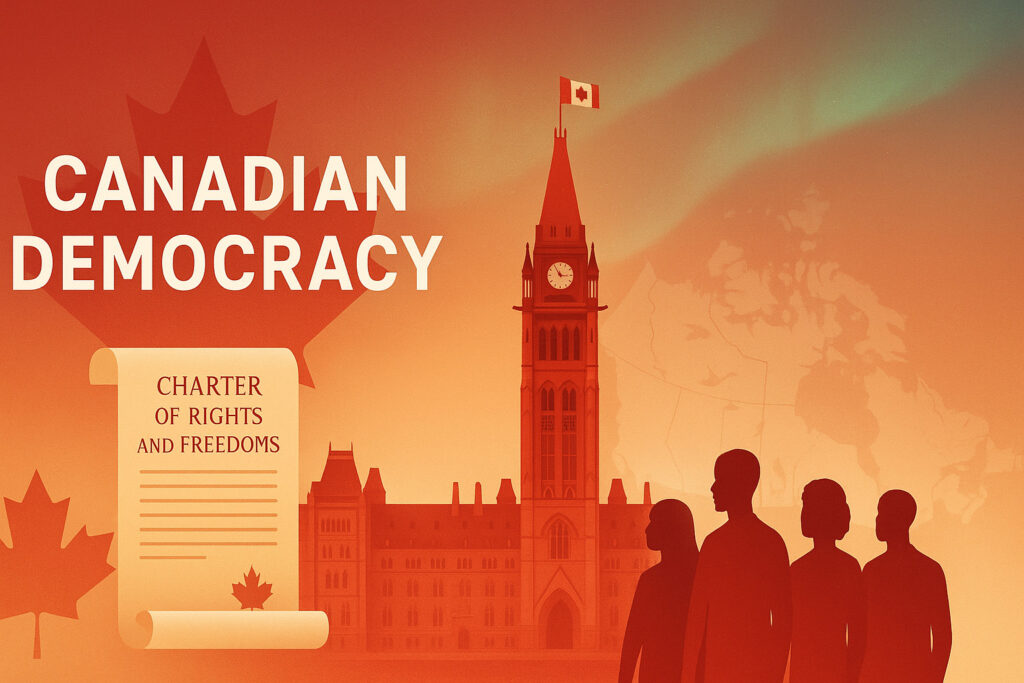
Canadian Democracy: Its History, Evolution, and How It Works Today
Canadian democracy is the result of centuries of political development, compromise, and cultural negotiation. What exists today—a constitutional monarchy with a parliamentary system—stands on foundations laid by French and British colonial institutions, and the gradual, deliberate expansion of civil rights. Understanding Canadian democracy means understanding both its long evolution and the mechanisms that sustain it in the present.
Indigenous Foundations: Governance Before Confederation
Long before European arrival, Indigenous nations across the land now called Canada practiced sophisticated forms of governance.
- The Haudenosaunee Confederacy used consensus-based council systems.
- The Anishinaabe, Mi’kmaq, Cree, and many others made decisions through councils, clan systems, and community-based deliberation.
These forms were rooted in respect, shared responsibility, and collective well-being.
Colonial Beginnings: French and British Institutions
When France established New France in the 1600s, the colony was governed under a centralized monarchy. After the British conquest of New France in 1763, British legal and political structures began to take hold, culminating in the Constitutional Act of 1791, which split Quebec into Upper and Lower Canada and created elected legislative assemblies.
These assemblies had limited power—governors appointed by Britain controlled most decisions—but the seeds of representative democracy were planted.
Rebellion, Reform, and Responsible Government
Frustration with the lack of democratic control led to the Rebellions of 1837–38 in Upper and Lower Canada. Though the rebellions were unsuccessful, they prompted inquiries and reforms. In 1840, the Act of Union merged the two Canadas, and political leaders like Louis-Hippolyte LaFontaine and Robert Baldwin pushed for greater democratic accountability.
Their efforts helped secure responsible government in 1848. This principle—that a government must retain the confidence of the elected assembly—became the cornerstone of Canadian parliamentary democracy.
Confederation and the Birth of a Nation (1867)
On July 1, 1867, the British North America Act (now the Constitution Act, 1867) united Ontario, Quebec, Nova Scotia, and New Brunswick into the Dominion of Canada. Confederation created:
- A federal system, dividing powers between the federal and provincial governments.
- A parliamentary democracy, mirroring the British Westminster model.
- A constitutional monarchy, with the monarch represented by the Governor General.
Over time, more provinces and territories joined, expanding Canada from coast to coast to coast.
Democratic Expansion: Voting Rights and Civil Liberties
Canadian democracy expanded gradually through major reforms:
- 1870–1960: Most provinces removed property requirements for voting.
- 1918: Women gained the federal right to vote (earlier in some provinces).
- 1940: Quebec became the last province to extend voting rights to women.
- 1960: All Indigenous people gained the unrestricted right to vote in federal elections without giving up treaty rights.
- 1982: The Constitution Act, 1982 and the Canadian Charter of Rights and Freedoms entrenched civil liberties, equality rights, and fundamental freedoms.
Today, these rights form the legal backbone of Canadian democratic life.
How Canadian Democracy Works Today
1. Constitutional Monarchy
Canada recognizes the British monarch as head of state. The monarch’s powers are largely ceremonial and exercised by the Governor General federally and Lieutenants Governor provincially. Their key constitutional roles include:
- Granting Royal Assent to legislation
- Appointing the Prime Minister (normally the leader with the confidence of the House)
- Calling elections and dissolving Parliament
While these powers can be significant in rare circumstances, they are guided by constitutional conventions rather than direct political influence.
2. Parliamentary Democracy
Canada’s federal government has three main branches:
The Executive
- Prime Minister: head of government, leader of the majority party or coalition.
- Cabinet: ministers responsible for government departments.
- Governor General: ceremonial head of state representation.
The Legislature
- House of Commons: 338 elected Members of Parliament (MPs).
- Senate: about 105 appointed members who review legislation.
Laws must pass both houses before receiving Royal Assent.
The Judiciary
An independent system culminating in the Supreme Court of Canada, which interprets the Constitution and protects rights under the Charter.
3. Elections and Political Parties
Federal elections usually occur every four years, but may happen sooner if the government loses a confidence vote or the Prime Minister requests dissolution.
Canada uses a first-past-the-post electoral system:
- The country is divided into ridings.
- Each riding elects one MP.
- The party with the most seats normally forms government.
Canadians vote for local representatives, not directly for the Prime Minister.
4. Federalism
Powers are divided between the federal and provincial/territorial governments:
- Federal: immigration, national defense, criminal law, currency, trade.
- Provincial: education, health care, civil law (in Quebec), natural resources.
- Shared: agriculture, transportation, environment (in practice).
Municipal governments operate under provincial authority.
Modern Challenges and Ongoing Evolution
Canadian democracy continues to adapt in response to:
- Calls for electoral reform
- Debates on Senate modernization
- Reconciliation and the recognition of Indigenous self-government
- Digital disinformation and foreign interference
- Political polarization and regional divides
Despite these pressures, Canada remains one of the world’s most stable democracies, grounded in rule of law, constitutional protections, and a long tradition of compromise.
Conclusion
Canadian democracy did not emerge overnight. It is the product of Indigenous traditions, colonial political evolution, rebellions for reform, and generations of citizens working to expand rights and representation. Today’s system balances monarchy and Parliament, federalism and local autonomy, majority rule and minority protections.
Its history shows a constant movement toward greater inclusion and accountability—and its future will depend on the continued engagement of Canadians in shaping and safeguarding their democratic institutions.